Category Archives: Sports

A Meaningless JV Baseball Game, a Timeless Memory

Below is another article in a series of blog entries I’m writing as a candidate for president of Red Sox Nation.

Before every little leaField of Dreamsgue game I coach, I remind myself that what’s about to unfold on the field might be forgotten by me and other spectators within a day, but that for one or two of the kids playing that day, something might happen that will be carved in their memories forever. The memory might be marvelous (home run), and it might be torturous (bonehead error), but it will endure in the player’s mind the rest of his days. If you ever played organized baseball at any level growing up, you know what I’m talking about.
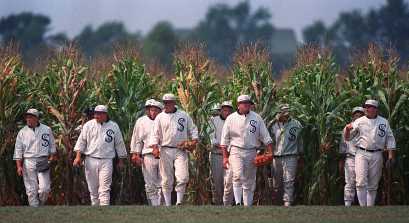
One of those baseball memories I’ll always carry around is of a game that took place my sophomore year in high school, in 1984, as a member of Brookline High’s JV baseball team. I was a skinny kid with a decent glove and strong throwing arm, but no bat. I was either the last or second-to-last player to make the team (and I still have the stubby stick I picked up off the ground and rubbed like a good luck charm as Coach Cohen read the names of players he was keeping on the last day of tryouts), and I knew I’d see very little playing time that year. That was OK with me. I was happy just to wear the uniform, to go to baseball practice after school every afternoon, and to sit on the bench with the guys, munching sunflower seeds and talking baseball.

Little did I know I wouldn’t see any game action until midway through the season, and that when I did finally play, the game’s outcome would depend on my individual performance. That moment came on a wet, overcast afternoon at Amory Field in Brookline, which is located just off of Beacon Street, about a half-mile from Fenway Park. It was the top of the last inning, we were ahead of Waltham High by one run, and they were batting with two outs and the tying run on second base. A beefy left-handed hitter approached the plate as I blissfully played catch with another sophomore behind the bench.

“Crawford!” rang Coach Cohen’s voice. I was jolted by the sound of my name and it took a full second for me to realize the coach needed me to do something. Pick up the helmets or straighten the bats, I assumed. But there was urgency in his voice. Brookline High School JV baseball team 1984“Crawford! Get in there for Jeff in right field. His arm’s sore. And if the ball comes to you, throw it home!” I grabbed my glove, pulled my hat on tight, and glanced over at my father, standing in his usual place behind the backstop. He smiled, winked, and pumped his fist, communicating wordlessly his faith and encouragement.
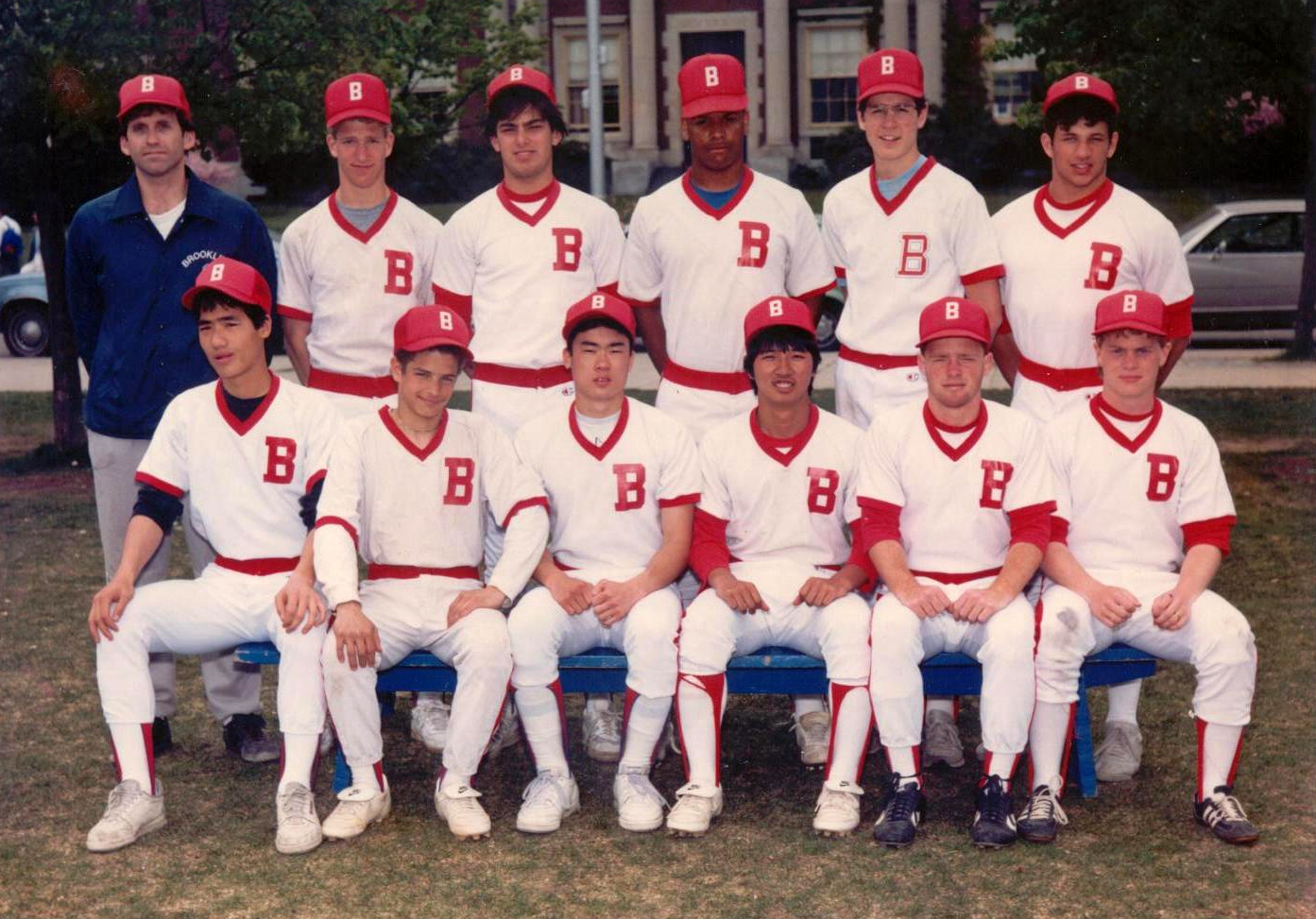
I sprinted towards right field, imagining myself to be rocket-armed Dwight Evans. “Two outs, Rob!” said Justin Walker, the second baseman, as I chugged by him. (Justin, front row, second from the left, later went on to an acting career and had a major role in the 1995 movie, Clueless. By some amazing coincidence, that BHS JV team’s first baseman, Joe Reitman, back row, far right, next to me, also went on to an acting career and also appeared in the movie Clueless.) It wasn’t until I reached my post in right and turned to face the diamond that I realized the dreadful mistake I had made before taking the field.

As I peered towards home plate from my unfamiliar post in right field, everything looked foggy. I blinked, but the fog remained. Suddenly, my heart stopped. My God. I forgot to put on my glasses. The reality of my plight spilled over me like icy water. My saliva tasted metallic and my legs wavered. I was too embarrassed to call time out. Oh God, please let that big lefty hit the ball to someone else. Please God, I begged silently. But God had already finalized his plans for that big left-handed hitter, the baseball, and me.

The big Waltham kid swung at the first pitch. Ping! The ball shot up into the sky and, to my horror, it entered the air space above me. All eyes turned to me as I jerked forward, believing the hit to be a shallow bloop. But three running steps forward and a new perspective on the white blur above me revealed a drastic error in my calculations: the ball had been socked, not blooped!

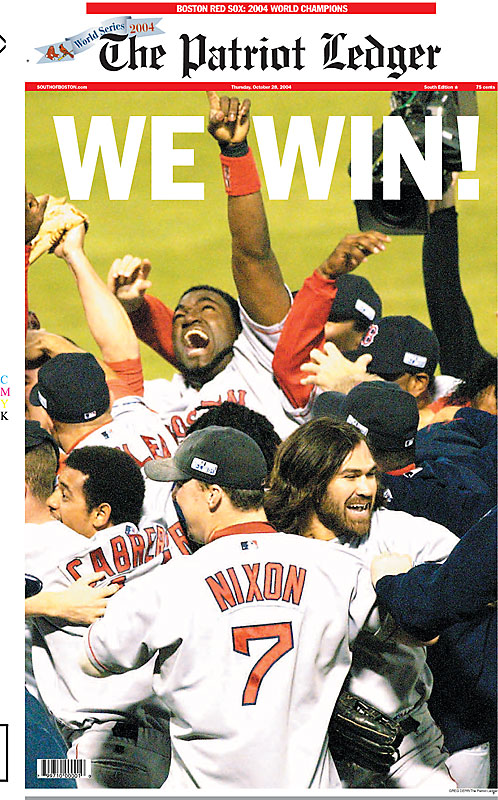
baseball catchTrying to change direction, I slipped on the muddy turf and fell to one hand and one knee. But I kept my eye on the hurtling white puff and bounced to my feet. Back, back, back I stumbled until I hit another wet spot and lost my balance. I fell backward, with my glove arm outstretched. Then, at the same moment I landed flat on my back in the cold, muddy outfield – plunk – the ball fell into my glove, Red Sox win!and I squeezed.
Rising to my feet, I held the ball proudly above my head, showing the umpires, my teammates, my coach, and my dad that I had caught it. We had won. Within seconds I was mobbed by my screaming, disbelieving teammates. What a moment! My father, who retells this story every time our family is together, recalls that, as Coach Cohen walked over to the Waltham coach to shake hands, he put his hat over his face as if to say, “Did we just see what we just saw?”

What does this story have to do with Red Sox Nation? Maybe something about how we all wonder how we would perform under the same pressure our Red Sox heroes face regularly. Or maybe it’s about the snapshots we all carry around about our own triumphs and failures. Or how the Red Sox bring out the dreamer in all of us. I don’t know. Maybe you do.
Slammin’ Scott Hatteberg ushers in “My Life, Part 2”

Below is another article in a series of blog entries I’m writing as a candidate for president of Red Sox Nation.

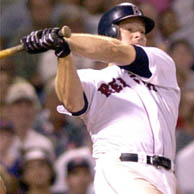
I’ve written before on this blog about my open heart surgery in 2001 to repair a ruptured sinus valsalva aneurysm. What I haven’t written about is the role that baseball, the Red Sox, and former Sox catcher Scott Hatteberg (below) played in the whole surgery-recovery experience.

Scott Hatteberg grand slamEarly in the morning on August 6, 2001, lying on my back in a hospital and nervous about having my chest sawed open, I was wheeled into an operating room feet first. I recall looking up at the room number and suddenly feeling totally comforted about the outcome of the surgery. Why? It was room 37. That was my uniform number during the ten years I pitched for Avi Nelson Club in the Yawkey Amateur Baseball League of Boston. I just knew that was a sign. A good sign. (Hey, even us amateur baseball players never lose our superstitions….)

Fast-forward about 15 hours to 9:30pm. The successful surgery had been completed by noon and I had been unconscious in the intensive care unit all afternoon and night. My wife, pregnant with child #2, had gone home to put our two year-old son to bed and my parents were sitting by my side, watching the Red Sox-Rangers game on the TV, waiting for me to wake up from my drug-induced haze. The doctors had told them I would probably open my eyes by midnight. Exhausted themselves from a long day at the hospital, my parents finally decided to go home too – but before they left, they asked the nurses, “Please don’t turn off the TV. If Rob wakes up with the Red Sox game on, he’ll be happy.”

Now, shift to my perspective. This is what I remember as I regained consciousness: I began to open my eyes, the room was dark except for the glowing TV, and the commentator was yelling something: “… long drive, way back, GRAND SLAM SCOTT HATTEBERG, and THE RED SOX TAKE BACK THE LEAD!”

At the precise moment I woke up from my surgery and realized I was still alive, Scott Hatteberg hit a go-ahead grand slam, sending Fenway fans into a delerious frenzy. I was all alone in the room at that moment – just me, Scott Hatteberg, and the screams of the Fenway Faithful. Needless to say, I was pretty emotional as I lay there in my bed — out of gratitude for a “second birth” and also moved by the in-your-face-baseball-joy playing out on my TV. I remember that my whole body was pretty sore, and I remember being simply amazed that that euphoric Red Sox moment was chosen for me to return to consciousness. It will always be one of my life’s most incredible memories.

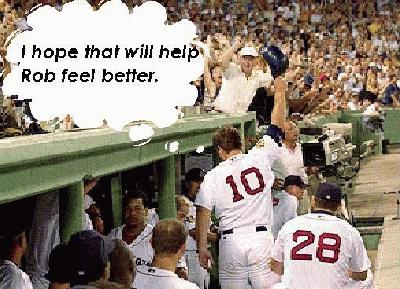
Hatteberg’s slam came in the bottom of the sixth inning, following the Rangers’ demoralizing five-run fifth inning, and neither the Red Sox nor the Rangers scored any more runs the rest of the game, resulting in a 10-7 victory for the Sox. (See box score here.) Interestingly, in Hatteberg’s previous at-bat in that game, he hit into a triple play, and his subsequent grand slam made him the first and only player in major league history to hit into a triple play then hit a grand slam in consecutive at bats. His bat from that game is on display at Cooperstown.Scott Hatteberg curtain call

Upon hearing this story of my dramatic “awakening,” one of my teaching colleagues, Matt Parke, now a basketball coach at Guilford College in North Carolina, doctored and then emailed me this photo of Hatteberg’s Fenway curtain call (right).

Someday, when Hatteberg (now a member of the Cincinnati Reds) is retired, I hope to meet him and tell him about how one of the best moments of his life was also one of the best moments of mine.

“I’m a Member of Red Sox Nation” — birth of a song

I have written a few Red Sox songs this summer. (I guess you could say writing baseball songs is a hobby — but the truth is, these tunes just come to me when I’m driving or hacking on my guitar.) One is called, There is Nothing Bettah, Than Beating Mariano Rivera. My kids like thakids bandt one. Another is called, On the Corner of Brookline Ave and Yawkey Way. This is the song I invited my songwriting friends, Dan Page and Michele Page, to come listen to about a week ago to help me write some lyrics. Just before they got to my house, the tune and first line of, I’m A Member of Red Sox Nation came to me. When Dan and Michele arrived, I didn’t even bother playing the Brookline Ave and Yawkey Way tune for them — I knew that the Nation song was the one we needed to work on. And we did.

It was a good time. We filled pads of paper with Red Sox images, phrases, memories, and ideas, referred from time to time to our thesaurus and rhyming dictionary, wrote and rejected about 250 lines — and a few days later, the song was complete. I stayed up late a few nights recording/engineering it on my iBook (using Garage Band software and the Mac’s built-in mike) in my basement, which is also my kids’ playroom. Surrounded by Play-Doh, dolls, and Pokemon cards, I perched the laptop on the surface of our air hockey table, and if you listen to the song carefully, you can hear our loud basement fridge droning in the background.

A week after the basement sessions, my good friends Bob Little and Michelle Rufo, along with about ten other day camp counselors at Summer@Park, taught the song to about fifty campers and organized them for an informal recording session in the lobby of the school’s gym. The kids’ enthusiastic singing was added to the last verse, along with their favorite Red Sox cheer, “Let’s Go Red Sox!”

The song was played at Fenway Park between the top and bottom of the fifth inning last Wednesday, July 18. If it has been played since then, I haven’t heard about it. Whether or not I’m elected president of Red Sox Nation, Dan, Michele, and I hope this song is good enough and gets enough play to get stuck in people’s heads across New England for years to come, making them smile every time they hear it. To read the lyrics, or to download the song for free, go here.

“Regular Rob” runs for president of Red Sox Nation

President of Red Sox NationYes, I am the “Regular Rob” who is running for president of Red Sox Nation – against quite a formidable group of “Nation notables.” I thought about starting a new blog for my campaign, but using my existing blog is just so much more convenient. Plus, it gives potential voters a chance to learn more about me from the other blog entries I’ve written since I started this blog in November, 2006, when I was writing for an audience of about 47 — on a very good day.

You will notice that my last entry, prior to this one, was written near the end of March. Why did I stop writing? Same reason I started: baseball season. In November, when I wrote my first blog entry, the 2006 baseball season had recently ended and I had time on my hands in the evenings after the kids were in bed. On April 2, the major league baseball season started, and I suddenly didn’t have that time anymore. I was glued to the Sox games on NESN and ESPN’s Baseball Tonight again, as well as managing my Yahoo fantasy baseball team in hopes of ending my brother’s remarkable seven-year reign in the Crawdaddy League.

So, I’m back (I know, you never knew I was gone), and it’s not even November yet. If elected president of Red Sox Nation, I’ll be a frequent blogger on my family’s Red Sox Nation experience, on baseball and Red Sox memories of mine, and on any current Red Sox Nation topics I feel like addressing. I expect I’ll also reach out to Red Sox Nation through this blog to ask my compatriots for their thoughts, opinions, and ideas, so I can serve both the Red Sox organization and Red Sox Nation by being an effective liaison between the fans and the team.

So, if I’ll be blogging as president of RSN on these topics, why not blog on these topics now? I think I will…. should be fun….. though I’ll need to learn to write late at night while watching baseball on the tube….

Professionals

I remember when I was a young boy, sometimes in the summer my father and I would walk down to the baseball field in Cleveland Circle to watch a men’s amateur league game. We’d stand right behind the backstop, and I vividly remember the terrifying velocity on those fastballs, and I can hear in my head the deafening wham of the ball smashing into catcher’s mitt, and I recall watching hitters barely flinch when a pitch went zinging by, and I remember the exact feeling I had watching all this. I thought, “These guys are so incredibly, inconceivably good. And they’re not even professionals.”Collings guitar

In my 20s, I actually played in that men’s amateur baseball league and enjoyed several good years pitching for Avi Nelson Club. But even the best players among us were not nearly good enough to play at the lowest levels of minor league baseball. There were no scouts at our games. We were all amateurs. Happy amateurs.

I was reminded of this amateur-professional idea last Wednesday night, when I had the good fortune to accompany my friend, songwriter Dan Page, on guitar and background vocals at his show in New York City. Dan is widely admired in music circles, and about fifteen of his musical friends (including the amazing Mark Nadler and many members of the extraordinary Sullivan family) came from all over the country to perform in this show, which featured Dan’s most enduring compositions. Dan asked me to back him up on two songs – the first two songs of the show – and, humbled and honored, I quickly agreed.

The thing is, I was the only amateur musician who participated. Everyone else that plugged into an amp or sang into a mike that night was a pro. And, my God, was I out of my league.

I played all the chords just fine, and I sang my harmony nicely. But I had prepared only for things to go exactly as we had rehearsed, and that’s rarely the way things go when the show is on. The order of verses can get switched without warning, the bridge can get skipped, the pause before the final chorus can get extended, etc. Pros handle these “invisible blunders” with grace and ease. I think they actually love it when things don’t go according to plan. I may have risen to the occasion last Wednesday night, but I sure didn’t feel like a pro when the surprises came along.

The bass player that night, Ritt Henn, was a true pro. He was reading the sheet music for all of these songs for the first time, on stage, and not only performing the songs flawlessly, but adding flourishes at just the right moments and rolling with all the “invisible blunders” of the guitarists, pianists, and vocalists with which he shared the stage – and doing it all with a big smile on his face. (I wrote to Ritt and referred to him as “the Derek Jeter of bass players,” and he wrote back, “Hey, wait a minute…you guys are Red Sox fans, right? Is that some kind of insult or something? (insert appropriate smiley faced icon here) Thanks for the kind words…it’s fun winging it, and it was a kick playing with all those different folks, and thank you (and the entire Red Sox Nation) for recognizing and admiring Mr. Jeter’s prowess…. y’know, the year you guys won, I was actually rooting for you.”)

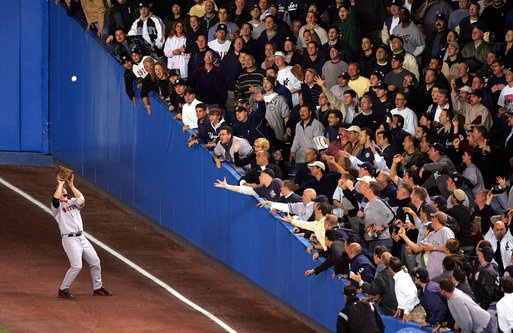
Trot NixonPerforming with Ritt Henn and all those pros was like being asked to play right field for two innings of a Major League Baseball game. I thought, “I can catch a fly ball. I’ve done this a million times.” But in real games, easy flies are intermingled with screaming line drives in the gap, violently bad hops, jeering Yankee fans (see photo), and split-second decisions about which base to throw to. Pros react to these unpredictable challenges as though they expected them — because they’ve practiced for the unexpected their whole lives — and even in the most unusual situations, they execute flawlessly. A pro hits his tee shot into the sand on the 18th hole at Augusta National — and still saves par.

That’s what I learned last Wednesday night in New York. I may know how to play those chords and sing that harmony – I may know how to catch a fly ball – I may know how to drive a golf ball into the fairway – but I’m an amateur. A happy amateur. (Although it sure is fun to hang out with and learn from professionals…)

Never Say “I Could Have Done That”

Creative ideas.

Images of a different, better future.

We all have five or ten compelling ones every day. Sometimes they hit us in the shower. Sometimes while we’re driving. Sometimes when we’re sitting in a meeting oMJ on the Baronsr while talking with a friend. Sometimes they wake us up at 3 in the morning.

And I bet at least one idea we have per day is one that, if acted on, could make a quantum, dramatic difference in our lives or the lives of others. It’s one that could help define our lives and our purpose on this planet if we could execute it. If only these gem-like ideas could be highlighted for us, and we could be guided by a higher power to follow-through on them immediately….

Frequently, I see the work someone else has done – the book or song they wrote that I know I could have created as well, the product they invented that I had the concept for a few years ago, the eye-opening presentation they gave at the conference, the physical condition they’ve gotten themselves into and the accomplishments they’ve achieved because of this – and my impulse is to say, “Well, I had could have done that, too.”

But I didn’t, and that is all that really matters. I may have had the idea. I may have had the ability. I may have had the desire and even the intention. But all the credit goes to the one who takes the idea and, at the very least, strives to forge it into a real thing, a real accomplishment, a real victory, a real process, a real piece of art, a real conversation, a real relationship, a real habit, a real action.

The line between “having an idea” and “executing an idea” is thin – and yet the difference in value between the two is infinite. An idea or goal that stays in your head is as good as an idea or goal that never existed.

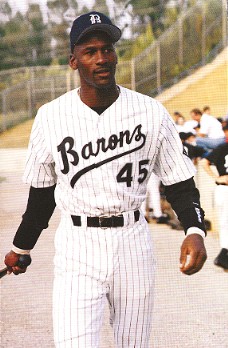
I love the example of Michael Jordan’s short baseball career for two reasons:

1. Michael says he always dreamed of being a major league baseball player and believed he could compete at the highest levels in that sport. Most of us forget that he retired from the NBA as reigning MVP in order to follow through on this dream and start a new career in baseball. Is there a better example of never saying, ‘I could have done that?’ That was one of the most inspiring career leaps I’ve ever seen.

2. M.J. never made it to the majors, but you won’t hear Michael say, “I could have done that,” while watching David Ortiz or Ichiro Suzuki hit a 97-mph tailing fastball for a game-winning hit. He tested out his idea and learned that baseball was much harder than he imagined. But, at least with regard to this single idea, Michael can sleep at night knowing he didn’t let it die in his head.

Then there’s my sister-in-law, Christina Harding. She heard about the Antarctica Marathon a couple of years ago and said to herself, “I never want to just say, ‘I could have done that.’ Therefore, I must do it.” Last week, she competed in the Antarctica Marathon. Like Michael Jordan, she can now say, “I followed through on my idea.” Unlike Michael Jordan, Christina can also say, “And I reached the pinnacle.” Because she won, defeating all other female entrants in the race and passing two competitors in the race’s final two miles of glacier-covered terrain. Incredible.

I have learned to never say, ‘I could have done that.’ Because I didn’t.

The Origins of Expertise

boy practicing tennisWe can all point to clear evidence showing that elite performers – in all areas – possess innate strengths that give them an edge over the rest of the crowd. For example, Shaquille O’Neal’s body gives him an edge in professional basketball, and composers such as Bach, Mozart, and Beethoven obviously had musical talents that set them apart from generations of artists. But is “talent” really the core ingredient of expertise and elite performance?

An interview entitled, The Expert on Experts, from Fast Company’s November 2006 issue, illuminates “expertise” in a different light, and suggests that my examples above are extreme exceptions to the typical evolution of expertise. The interview’s subject is K. Anders Ericsson, professor of psychology at Florida State University and author of the 918-page Cambridge Handbook of Expertise and Expert Performance. Ericsson says:

“With the exception of some sports, no characteristic of the brain or body constrains an individual from reaching an expert level….Elite performers aren’t genetically superior. They spontaneously do things differently from those individuals who stagnate. They have different practice histories. Elite performers engage in what we call deliberate practice – an effortful activity designed to improve target performance….. In general, elite performers utilize some technique that isn’t well known or widely practiced.”

I was recently reminded of this Fast Company article when reading Brad Gilbert’s book, I’ve Got Your Back: Coaching Top Performers from Center Court to the Corner Office. Gilbert is a former top-ten tennis pro who later coached #1 players, Andre Agassi and Andy Roddick. As a youngster, Gilbert was always a good player but he never stood out as a future star. He received a tennis scholarship to a junior college, eventually transferred to Pepperdine University, joined the ATP tour, and slowly worked his way from #180 in the world to his peak ranking of #4.

It was this paragraph from Gilbert’s book that struck me:

“I guess a couple of things made me different from other up-and-comers on the tour. Sure, I had resilience and foot speed. But other guys had those traits. What set me apart, maybe, was my eye for the game, my memory of how people played it, and my drive to pay attention. Almost every other guy on the tour, when he was finished with his match, couldn’t wait to get the hell out of there – to go back to the hotel room to watch TV, or go pound a few beers. Call me nutty (and a few people did), but I loved to hang out at the venue: watching matches or practice, shooting the breeze with guys in the locker room or training area. And whenever I was watching tennis, I was taking notes. I kept a little black book on every guy I played, and every guy I saw playing…. if you know the other guy’s weaknesses, you have a huge leg up.”

Later in the book, when Gilbert explains how he helped Andre Agassi improve from a #30 world-ranking to #1, the “black book” technique is featured once again.

Steven D. Leavitt and Stephen J. Dubner (authors of the interesting book, Freakonomics) wrote this about Ericsson’s expertise book in The New York Times Magazine:

The Cambridge Handbook of Expertise and Expert Performance makes a rather startling assertion: the trait we commonly call talent is highly overrated. Or, put another way, expert performers – whether in memory or surgery, ballet or computer programming – are nearly always made, not born. And yes, practice does make perfect.”

I find it amazing – and thrilling – that good performers can become elite performers through “deliberate practice” and “utilizing some technique that isn’t widely known or widely practiced.” And I find it fascinating that, since natural talent isn’t the central reason for superior performance and any of us can become an elite performer in an area that deeply interests us, we aren’t all among the “elite” in something.

Clearly, everyone has a choice: to become an expert or elite performer in an area of our choosing, or to be a generalist. (And while “generalist” implies mediocrity and dulled impact, we can always turn to Benjamin Franklin and Babe Didrikson Zaharias, two “expert generalists,” for stunning counter examples…)

In Pursuit Of The Zone

“When am I in the zone, and how will I double the time I spend in the zone in the next 12 months?”

Entrepreneur and author Raj Setty has been publishing “Quoughts of the Day” on his blog since late December, 2006. (A “quought” is a question that provokes thought.) Back on January 13, I wrote about Raj’s excellent “quoughts” series and suggested three quoughts of my own. Since then, Raj and I have become acquainted via email, and today he has published my quought at LifeBeyondCodeBlog.

I’m a big fan of “being in the zone.” I believe we all do our best work when we’re in the zone. Almost all really, really great work is produced by people in the zone. Entrepreneurs. Athletes. Teachers. Writers. Doctors. Salespeople. Musicians. Architects. Chefs. Gardeners. Artists. Preachers. Mothers. Fathers. Students. CEOs. Auto Mechanics. The elite ones get “locked-in” when they’re practicing their craft.

I believe we need to spend at least a few hours every day in the zone, or we’re depriving the world (and ourselves) of our most valuable stuff. I worry about people I love who don’t appear to spend any time in the zone during the day.

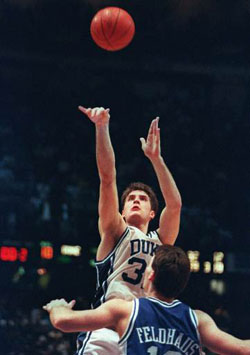
Christian LaettnerWhen in your lifetime, including when you were a kid, do you remember being in the zone? (If you’re Christian Laettner (left), you remember being in the zone on the night you took this shot, with 0.2 seconds left, after catching an 80-foot pass from Grant Hill, to win the 1992 East Regional NCAA Tournament game in overtime against Kentucky, 103-102. Laettner was 10 for 10 from the floor, and 10 for 10 on free throws in this game. That’s some serious zoneage. The story of this game is here.)

Can you pepper your schedule next week – and for the rest of your life – with more “zone-time?”

“Work is my obsession but it is also my devotion…. Absorbedness is the paradise of work.” — Donald Hall, poet and essayist

A Golfer In My Own Mind

Tom WatsonThe third round of the Pebble Beach Pro-Am was on TV in the background today as I supervised and played with my 4 small children (yes, that’s Tom Watson at Pebble Beach, left), and it got me thinking…

I have probably played a total of 50 rounds of golf in my entire life (perhaps 2 per year since 7th grade). How, then, can I justify calling myself a golfer?

Perhaps it’s because I imagine playing golf all the time; I read books about golf (The Legend of Bagger Vance, by Steven Pressfield, is one of my all-time favorite novels); my son and I compete in Yahoo’s online golf league together; in the summer, I’m constantly trying to find a way to squeeze in nine holes; when I do find time to get out on the golf course, I feel a level of peace, freedom, and competitive focus attainable in no other way.

Why does this game have such a hold over me, and over so many others? What is it about this sport that makes it so addictive, so engaging, so exhilarating — even for hacking amateurs like me?

Most importantly, how can you and I quadruple our annual golfing time during the course of the rest of our lives?

“I asked Arnold Palmer if he’d ever come close to mastering the game of golf; he said he thought he had once, for nine holes.” — Fuzzy Zoeller, from Be The Ball: A Golf Instruction Book for the Mind

Are You Measuring The Right Things?

Wrigley’s fenceSeth Godin describes an example today on his blog that shows that “just because you can measure it doesn’t mean it’s important.” It reminded me of a great book about measurements – indeed, one of the best non-fiction books I’ve ever read.

Have any of you read Michael Lewis’s book, Moneyball: The Art of Winning An Unfair Game? (Even if you couldn’t care less about sports, you’ll enjoy this book.) It’s a fascinating story that provides a perfect example of how “knowing what to measure” can have a dramatic impact on an organization’s results.

A few years ago, the general manager of the Oakland A’s, Billy Beane, set out with some MIT stat geeks to figure out what player statistics correlate most closely to “scoring runs.” What they discovered enabled them to compete on a different level in the game of selecting players. While every other team pursued players with high “batting averages” and “home run totals,” the A’s had figured out that these stats weren’t actually the most important when seeking players who would help you WIN (which is, of course, the ultimate goal).

They learned that “high on-base percentage” and “high slugging percentage” were the statistical qualities that contributed most to winning games — and that many of the players with the best stats in these areas were either overlooked by other teams (who had their eye on the wrong measurements), or undervalued in terms of salary. So, on one of the smallest budgets in all of baseball, the A’s put together a team that competed for the World Championship several years in a row.

How’d they do it? They asked the right questions, did some analysis, and figured out the right things to measure to identify players who could help them achieve their ultimate goal of winning – then they adjusted their game plan accordingly.

What if you could engineer a surge in your results in your own field, similar to the A’s surge in victories, by starting to measure the right things?

Sustaining “Pure” Self-Confidence

My most recent article over at Lifehack.org tells about the “life list” my 7 year-old son has been composing over the last couple of months – on his own. I stumbled across his list about a week ago (modeled after John Goddard’s life list), and it has led me to ponder the question, “What difference do goals make, anyway?”

I recall hearing a terrific quotation from David Allen about goals. He said: “The value of goals is not the future they describe, but the change in perception of reality they foster, and the change in performance they effect right now, inside of you.”

hell freezes over(Re-read that quotation… it’s a great one.)

I love that my son believes that anything he can dream is possible. I love that that’s his reality. (“It’s not over, Daddy,” he says frequently, when watching a sports event whose outcome seems obvious. “Anything can happen.”) His life list reflects his expectation that he will eventually fulfill his loftiest aspirations (whether this is accurate or not is irrelevant) and if David Allen’s quotation is accurate, today and tomorrow he’ll “perform” with the pure self-confidence that fuels all great lives.

My challenge as his parent is this: How can I help him sustain his self-confidence, optimism, and possibility-thinking and carry it into adolescence and adulthood?

(To read my original article, My 7 Year-Old Son’s Life Listclick here.)

Who Are Your Most Beloved Athletes?

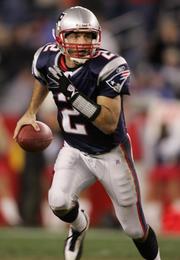
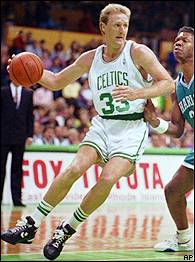
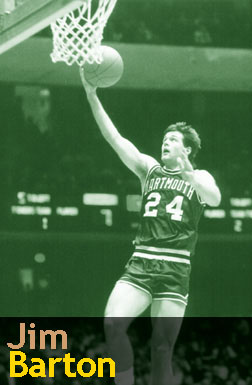
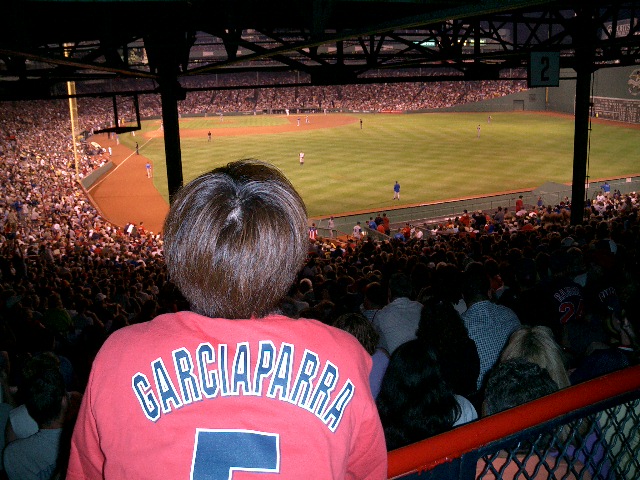
Writing abodoug flutieut how great athletes talk to themselves got me thinking about my favorite athletes of all-time. Four of the individuals on my distinguished list rise above the rest because of the place they hold in my heart, and because of the influence they had on me as a teenager and young adult. And, looking at the quartet, I am struck by the similarities between the three and the common characteristics they taught me to admire and emulate. The magic foursome is: Doug Flutie, Larry Bird, Jim Barton, and Nomar Garciaparra.

Doug Flutie. I was sixteen in 1984 when he threw the hail mary pass to Gerard Phelan to lead Boston College to victory over University of Miami. His 21-year pro career was just like his college clarry birdareer: he was smaller than every other NFL quarterback, but he found ways to win, time after time. And he never did it the same way twice – he was the king of improv.

Larry Bird. I was 17 that spring the Celtics beat the Lakers in the NBA Finals (1986). My dad always used to say, “Remember Larry, because you won’t see anyone like him the rest of your life.” It’s not Larry’s clutch shots and passes I remember first, it’s his hustle, diving to the floor to grab control of a loose ball, slamming his chin on the court. Larry was a warrior.

Jim Barton, Dartmouth basketballJim Barton. Jim was a star basketball player at Dartmouth College in the late 1980s when I was a student there. He could catch a pass and get off a shot in one instantaneous motion — and it always went in. His heroics made me lose my voice every game. He was among the nation’s scoring leaders, and at the time, I had never witnessed a more electric athlete in person.

Nomar. As a member of the Red Sox, his love for playing baseball was obvious, and even though he was an Nomar Garciaparra t-shirtall-star, he was humble and appreciated his success. He seemed to be hustling every minute of the game, even in the dugout (mentally). He was my first son’s first favorite Sox player, which has cemented him among my top-four favorite athletes. At the age of 5, he cried when Nomar was traded to the Cubs. He still wears his Red Sox-Nomar shirt, as well as his Cubs-Nomar shirt, and at the time Nomar signed his glove, it was probably the greatest moment of his young life.

Nice list, but why does it matter?

These great athletes were also great teachers of mine. Through countless emotionally-charged athletic performances, they helped develop my world view: the belief that anything can happen if you can imagine it; that the game isn’t over until it’s over, so you must never quit; that calm, confident focus can tame the highest-pressure moments; that spectacular results hurtle towards us when we’re “in the zone;” that the team’s goal of winning supercedes individual accomplishments; and that there is nobility in playing hurt and hustling on every play.

Who are your most beloved athletes, and how have they helped shape your world view?

What if Muhammad Ali Believed He Would Fail?

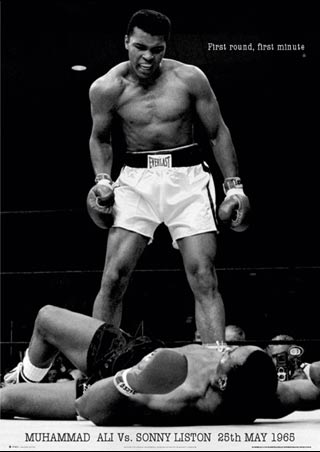
Ali pounds ListonI recently posted an article over at Lifehack.org about the motivational potency of reminding myself, “Not exercising is like taking a brain damage pill.”

This got me thinking about the importance of how we talk to ourselves inside our own heads. Don’t think it’s that big a deal? Consider this question:

How would the history of sports be different if Martina Navratilova, Jack Nicklaus, Muhammad Ali, Joe Montana, Nadia Comaneci, David Ortiz, and Michael Jordan all had the habit of thinking to themselves, “You’re going to choke – you can’t do it – here comes disaster!” just prior to the most critical moments in their athletic careers?

An absurd notion, I know — which underscores the fundamental power of the words we use (and don’t use) in our heads, every moment of every day.

Jack Kent Cooke’s letter to me about “success”

jack kent cookeIn 1993, as a 25 year-old middle school teacher, I wrote a letter to every owner of every major sports franchise (hockey, basketball, baseball, football) along with every MLB general manager, introducing myself and asking for advice on “how to be successful.” At the time, I aspired to own a team or become an MLB general manager.


I received about ten personalized letters or phone calls in return, including great letters from Daniel Rooney, president of the Steelers (“Since the Steelers were founded by my father in 1933, I happened to have an “in” with the owner”), John Schuerholz, GM of the Atlanta Braves (“I am somewhat dismayed that a person with the amount of passion you display for teaching and the great rewards it offers might be motivated to leave that great profession for other pursuits”), and kind and supportive calls from Bob Watson (then-GM of the Houston Astros) and Bob Harlan (Chairman and CEO of the Green Bay Packers). But the big daddy of all responses came from Jack Kent Cooke (1912-1997) (pictured above), the former owner of the Los Angeles Lakers and Washington Redskins.


His letter is one of the best – if not THE best letter – I have ever received. I wish you could hold it in your hands – the ivory-colored stationery itself is truly awesome, with an old-time Redskins helment at the top and ‘The Redskins’ in snazzy red letters. At the bottom of the stationery are Super Bowl banners: “Super Bowl XVII Champions – Super Bowl XXII Champions – Super Bowl XXVI Champions,” and at the end of the letter is Mr. Cooke’s elegant John Hancock, signed with his own pen. I’ll share the letter in its entirety here, in its exact original format; it’s the kind of letter that would be sinful to keep to myself:


December 2, 1993


Dear Mr. Crawford


Thank you for your pleasant letter of November 27th, which I received today. I regret that I cannot come up with an easy, simple recipe for success since I believe there’s not a surefire method of reaching the top. But for starters I believe that humanity is divided into three parts:


a) Those who make things happen, b) Those who watch things happen, and c) Those who don’t know what’s happening.


In the course of my life I’ve run across maxims which seem to relate to success. But don’t forget that success frequently is a state of mind rather than a material pinnacle. So, here are a few of those thoughts I have found helpful:


Glory

Robert Burns: “A man’s reach should exceed his grasp or what’s a heaven for.”

Dizzy Dean: “It ain’t braggin’ if ya done it.”


Courage

John Dryden: “I am a little hurt but I am not slain and I will lay me down for to bleed a while then I’ll rise and fight with you again.”


Luck

Branch Rickey: “Luck is the residue of the design.”

Lord Thomson of Fleet: “Funny thing, the harder I work the luckier I get.”

Eubie Blake: “Be grateful for luck. Pay the thunder no mind – listen to the birds. And don’t hate nobody.”

Louis Pasteur: “Fortune smiles on the man who is prepared.”


Practices vs. Theory

Anonymous: “Some Greeks had been sitting on a wall for over a week theorizing which would fall first, a feather or a pellet of lead of the same weight. A Roman came along, listened a few minutes and said, ‘For God’s sake, drop them and find out’.”


Preparedness

Admiral Horatio Nelson: Said he owed his success to “Being there five minutes ahead of the other chaps.”


Intuition

The Bible: “That which is essential cannot be seen with the eye. Only with the heart can one know it rightly.”


The Future

Shakespeare: “Things without all remedy should be without regard. What’s done is done.”


Determination

Churchill: a) “It’s no use saying, ‘We are doing our best.’ You have got to succeed in doing what is necessary.” b) “Never talk monkey when the organ grinder is in the room.”

Henley: “Out of the night that covers me, Black as the pitch from pole to pole, I thank whatever gods may be, For my unconquerable soul.”


Energy

Anonymous: “Enthusiasm is akin to genius.”


Age

Satchel Paige: “How old would you be if you didn’t know how old you were?” b) “Age is a matter of mind over matter. If you don’t mind, it doesn’t matter.”


All The Rules Rolled Into One

Satchel Paige: a) “Avoid fried meats which angry up the blood.” b) “Avoid running at all times. Don’t look back. Something might be gaining on you.”

Carl Rowan: “Every sickness ain’t death, and every goodbye ain’t gone.”

T.S. Eliot: a) “Humility is the most difficult of all virtues to achieve.” b) “Nothing dies harder than the desire to think well of oneself.”


I can only add that it has always seemed to me that if you want something more than anyone else in the world wants it, and that if you’re willing to exercise the utmost intelligence and industry to get it, it will be yours.


Best wishes for success.


Yours very truly


Jack Kent Cooke (personally signed, with the flair of a king)


(Now, do you see what I mean about it being one of the best letters of all time? I have repeated Mr. Cooke’s philosophy on the three parts of humanity, and his final sentence about wanting something more than anyone else, many times to many people. Now, I have finally shared it with everyone else in the world.)