Category Archives: Family

Red Sox Nation: A Way of Life

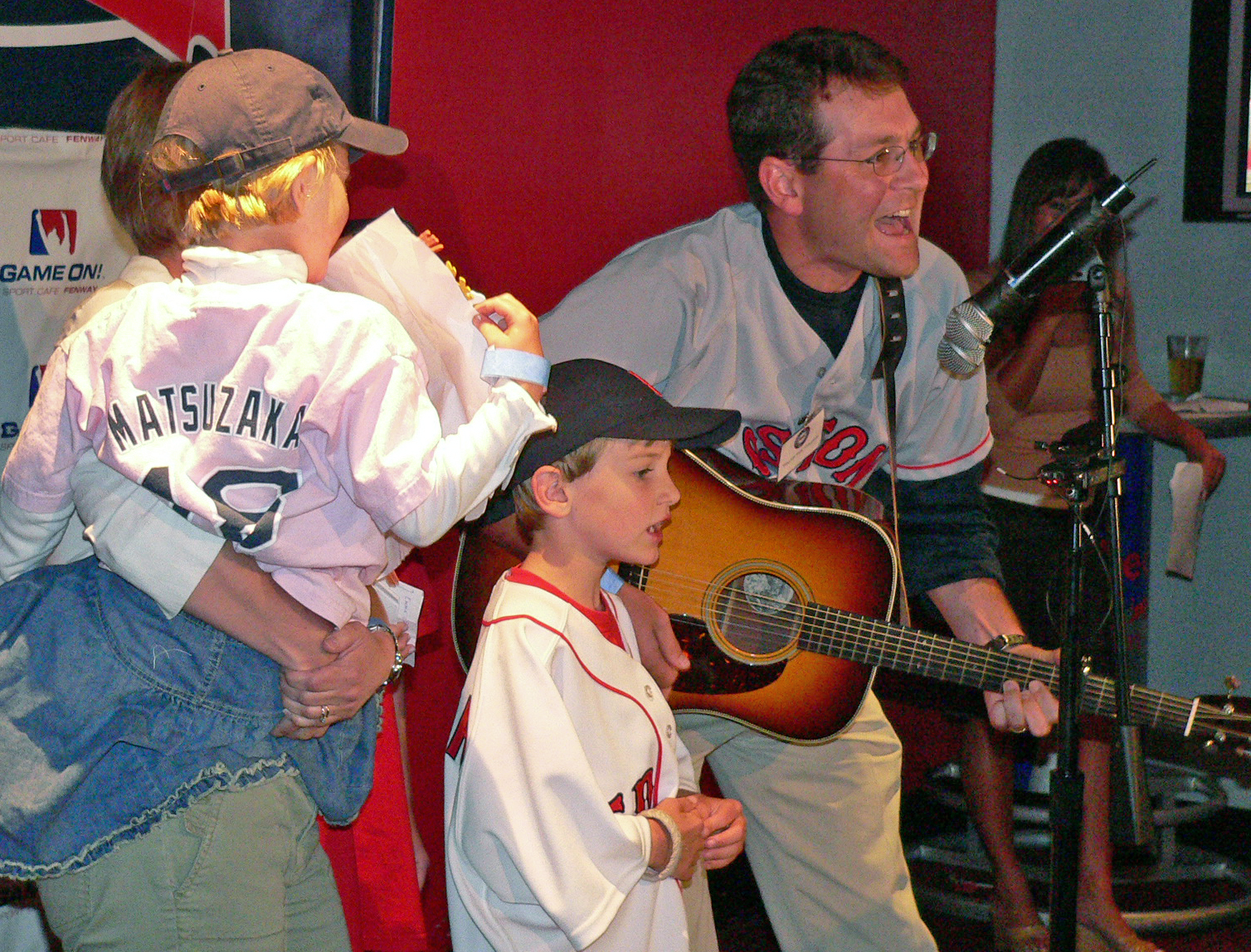
WHRBThis past Saturday, I was invited to appear on WHRB-FM’s famous country/folk music show, Hillbilly at Harvard, and to perform my song, I’m a Member of Red Sox Nation, live on the air. It’s always been a crazy dream of mine to have a song on the radio, so I didn’t hesitate to accept the invitation. And it was a great time. The show’s host, “Cousin Lynn” Joiner (second from left), made me feel right at home during our interview, and then we filled the studio with my song…. “we” being my co-writers, Michele and Dan Page (right), plus their 10 year-old granddaughter and my 8 year-old son, all of whom sang backup vocals. Who knows how it all sounded out in radio-land, but we had a blast. I want to thank Cousin Lynn for making it all possible. It was an honor to be on your legendary radio show.

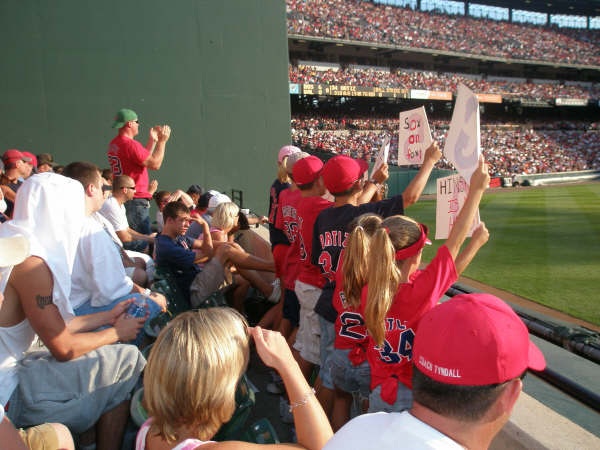
I was struck by one of Cousin Lynn’s questions. He said, smiling, “So, you’re running for the presidency of a concept?” He was pointing out the absurdity of electing a “president of Red Sox Nation.” Today, I thought more about that. Red Sox Nation…. Is it a band of millions of loyal Red Sox fans? Or is it an emotion? A state of mind? A culture? Well yes, it’s all of these things. But most of all, it’s a way of life. And as I and other members of RSN go through our daily lives, the Red Sox and baseball are literally everywhere we turn. I’m sure your house is a lot like mine….

Baseball gloves are everywhere… Baseball_gloves_everywhere2_2 Baseball_gloves_everywhere_2


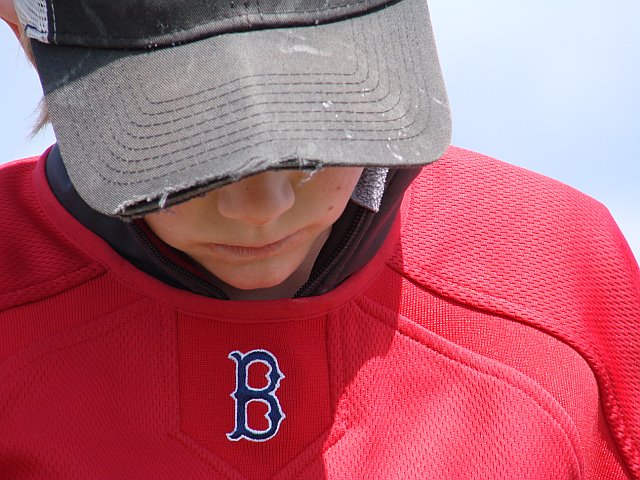
Our love for the Red Sox is evident in our closets, where our many hats live, as well as in our laundry baskets and our children’s drawers. Baseball_hats_in_closet_1 Baseball_laundry_basket_3 Baseball_drawer_open_2

RSN calls to us from our children’s walls and game closets…. Baseball_posters_on_wall_1Baseball_game_closet_1

… and from our bookcases and the backs of our cars.Baseball_bookshelf_2Baseball_rsn_sticker_3

Wiffle bats and balls reside in the yard (“Fenway West”)….Baseball_bats_in_backyard2_1 Baseball_balls_next_to_tree_1

… along with bases that our kids have stepped on and dove into thousands of times, imitating  Mueller or Crisp or Nomar or Roberts.Baseball_home_plate_in_backyard_2 Baseball_path_to_second_base_1

The kitchen isn’t just where we refuel, it’s where we pore over every word and every statistic in the Globe sports section, and where our Kid Nation fridge magnet schedule is displayed proudly.Baseball_paper_and_magazines_5Baseball_side_of_fridge_6

And of course, every night between April and October, the game is on, and with every up and down inning, we relive the great highs and lows we’ve experienced as Red Sox fans over the years.


So yes, Cousin Lynn, Red Sox Nation is a concept. A concept whose essence has infiltrated everything about my life and the lives of my many people I know, as well as the lives of millions of others worldwide. That’s one powerful “concept.” It’s a kind of insanity. Hard to imagine any other “way of life”…

This isn’t L.A., it’s Boston

This post also appears at the blog the Boston Red Sox have given me for my campaign for president of Red Sox Nation, at www.imamemberofredsoxnation.mlblogs.com. 

Tonight, there was an event at The Baseball Tavern, near Fenway, where 7 of the final 11 candidates for president of Red Sox Nation delivered five-minute campaign messages. I enjoyed meeting the other candidates who were able to attend – Jared Carrabis, Cheryl Boyd, Cindy Brown, Doris Kearns Goodwin, Sam Horn, and the family of the creator of Big Pupi. Below is the message I delivered.

Hi. My name is Rob Crawford, and I’m not famous. I’m not a TV baseball personality. I’ve never played for the Red Sox. My face is not on a plaque in Cooperstown. I have not won a Pulitzer Prize. And I don’t have a column in the New York Daily News.

I have devoted my career to teaching kids, coaching kids, and raising money to support teachers and kids. I grew up in a Sox-crazed family in Brookline, and I’m now raising four children, ages 1 to 8, in a Red Sox house, and loving every day of it. Like you, I am a “regular fan.”

Now I call myself a “regular fan” with no disdain for my worthy, famous opponents. I know their love for the Red Sox is as real and as passionate as any of ours is. And I like all of them. And I really, really respect all of them. In fact, they have all achieved things that I would have liked to have achieved.

But Red Sox Nation has a choice to make in this election. Does Red Sox Nation want its first president to be someone famous – someone for whom this office might be just another feather in his or her cap? Or do they want their first president to be representative of the “regular fan?” Someone whose life would be transformed by this honor? Someone who can relate to the millions of “regular” Red Sox fans around the world – because he/she is one?

I can see L.A. electing a celebrity to be president of Dodgers Nation or Lakers Nation — but in Boston? Inconceivable.

So, what will I do if elected?

The first priority I would have as president of Red Sox Nation would be to improve ticket accessibility, and I’d start with a program called Red Sox Angels.

Have you ever had a conversation with someone that revealed to you that the other person’s life would be deeply touched by tickets to a Red Sox game? And you knew that if you owned season tickets, you would give that four tickets right there on the spot? Perhaps their spouse, who is a huge Red Sox, is in the final stages of terminal cancer, and tickets would enable him to say “goodbye” to Fenway. Or perhaps she’s a single mother with three kids who’s struggling to make ends meet and could never conceive of taking her family to a game.

The Red Sox Angels program would put season tickets into the hands of Red Sox Angels across New England who would go through their daily lives looking and listening for people to give their tickets away to. Imagine the feeling of giving away Red Sox tickets to those who don’t expect it, and the feeling of receiving tickets when that’s precisely what you’re dreaming of! If the Red Sox were willing to donate 12 seats per year to this program, it would enable 24 Red Sox Angels to give away blocks of four tickets to ten games each season, resulting in 972 fans per year attending a game as a result of random but targeted generosity.

My second idea to improve ticket access is called, Sox Tix for Kids.

Almost no season ticket holder actually attends every Red Sox home game, and almost every season ticket hfans at Fenwayolder would love to donate at least one game’s tickets to a group of children who have never attended a game at Fenway, have no access to tickets to Fenway, but really want to go to a game at Fenway.

I envision a program that asks season ticket holders, on their season ticket renewal form, to donate one or more games’ tickets to the Sox Tix for Kids program. By doing so, they would be making a tax-deductible donation and would be spreading Red Sox joy to kids who, without this gift of tickets, would not be able to get inside Fenway Park and experience its mystery and magic first hand. A thank you letter from the kids to the donor of the tickets would be part of the system, and this would help encourage season ticket holders to make this gift year after year.

How would we identify these kids who want to go to a game, but have no access to tickets? Perhaps we would partner with Boys and Girls Clubs around New England; perhaps we would partner with the Boston Public Schools. The details need to be fleshed out, but since we were able to figure out how to put seats on top of the Green Monster, I have no doubt we can figure out how to get season ticket holders’ tickets into the hands of baseball-dreaming kids.

My third idea is called, More Dirty Water.

As many of you know, I love music, and as part of my campaign, I co-wrote and recorded a song called, I’m A Member of Red Sox Nation. I would love to use my platform as President of Red Sox Nation to bring together outstanding Boston-area musicians and other musical members of Red Sox Nation – famous and not-so-famous – to create a unique collection of great songs about the Red Sox, about Fenway, and about being a Boston sports fan. I envision all profits from this CD going to the Red Sox Foundation to support local charities.

I just don’t think it would be very hard to rally Red Sox Nation’s greatest musical artists to participate in a project of this kind, and I imagine it would add a new dimension to Red Sox Nation’s fan experience while providing a windfall for the Red Sox Foundation and the local Boston charities they support. Plus, it would be a heck of a lot of fun.

Now, before I close, let me leave you with this thought: Years from now, when this election is over and the first president’s term is a distant memory, the 6 or 7 famous candidates – regardless of whether they win or lose this election – will look back on this whole Red Sox Nation thing as having been another pleasant public relations bonanza, another famous experience in a lifetime of famous experiences. But for those of us in this campaign who are “regular fans,” THIS is our one chance to rise from our dignified obscurity and make a far-reaching impact. THIS is our chance to so something extraordinary. I know that us “regular fans” would look back on our year as President of Red Sox Nation as the greatest thing we ever did in our lives. And you would look back on our tenure filled with pride for having helped elect a true, non-famous representative of Red Sox Nation.

Red Sox Nation, I thank you. Remember, this isn’t L.A., it’s Boston, and Red Sox Nation deserves a “regular fan” as its first president.

Field of Dreams in My Backyard

Below is another article in a series I’ve written as a candidate for president of Red Sox Nation. This article also appears at the blog the Red Sox have given me, at www.imamemberofredsoxnation.mlblogs.com.

If there’s one regBackyard_robert_takes_a_leadular season game we’d all like to attend this year, it’s tonight’s game, Red Sox vs.Yankees, Schilling vs. Clemens. And I was offered a ticket, too. Turning it down was utterly painful, but with four small kids who need dinner, baths, and a bedtime story simultaneously, the teamwork of two parents is pretty important on a Sunday night. Don’t get me wrong, my wife can handle it all alone, but other married parents in Red Sox Nation will understand that, come September, it’s wise to save your chips for… the playoffs.

And anyway, no matter how great the game is tonight, it would be tough to match the fun I had today playing wiffle ball with my 8 year-old son and my 8 year-old nephew… on the baseball field in my backyard. That’s right. A few years ago, at my son’s request, we made a baseball field in our backyard. Fenway West. 68 feet to the Fisk Pole in left field, 56 feet to the Pesky Pole in right, 96 feet to dead center (and distance markers on the fences). Bases exactly 45 feet apart, foul lines painted white, and a pitcher’s mound 40 feet from home.

You like the idiosyncracies of Fenway? We’ve got those too. A sandbox full of toys in left, a swingset in right, and a gigantic oak tree next to the pitcher’s mound in the center of the field (ground rules: any ball that hits the tree in fair territory is fair and in play). There’s another big tree that looms in front of the left field fence (83 feet to straight-away left) that has the same effect on line drive blasts to left as the real Green Monster does… except sometimes the ball doesn’t come back down.

Backyard_left_field_and_center_2 The neighborhood kids who play ball in our backyard go to school every day and do their homework every night. But much of their most important education takes place right here after school and on the weekends. At Fenway West, they learn to organize themselves, to make compromises when disagreements arise, to play hard, and to never give up. They learn what it feels like to hit a clutch homer and to throw a third strike on a full count. They learn how to dream, they learn how to play.

Many of my neighbors have beautiful, green lawns. No one walks on them except when they’re being mowed. Our lawn can’t be called a lawn. It would be more accurate to call it a scraggly brownish earth surface. Grass doesn’t thrive when it’s trampled relentlessly by kids (and sometimes their dads) playing wiffle ball for hundreds of hours. The dirt patches at all the bases and the pitcher’s mound are now permanent, and the grass along the paths between the bases will probably never grow again. So be it.

Backyard_robert_and_william My wife worries that the barren baseball field in our backyard decreases the value of our house. I know better. If we ever decide to sell this place, the right buyer will see the house as a pleasant appendage to a marvelous field of dreams. Which is what our backyard has been for me, my kids, and their friends these last few years.

A week ago, my son had a homework assignment that asked him to describe his favorite thing about where he lives. His answer: “The baseball field.” That’s my favorite thing about where we live, too. Fenway West. A field of dreams in the heart of Red Sox Nation.

Career Home Runs: 1

Below is another article in a series I’m writing as part of my campaign for president of Red Sox Nation. To see the video for the song, “I’m A Member of Red Sox Nation,” or to download the song to your computer for free, click here.

From little league/youth baseball to high school to college to the Yawkey League, I played 22 baseball seasons and perhaps 500 games. Unlike Wade Boggs (whom I loved watching play, growing up), I don’t know any of my batting stats from my baseball career – except one. Total home runs: ONE. It happened when I was 14 years old, playing in Brookline’s Babe Ruth League at the playground next to Lawrence School, which is about 1 1/2 miles from Fenway Park.

I remember there were no fences – so any four-bagger would have to be legged out. I don’t remember the pitch but it was probably a 57 mph fastball right down the middle. When I struck the ball on the sweet spot of my ultra-light, 29 oz aluminum bat and saw its impressive arc, I knew this was my chance. As I sprinted towards first base, I was already focused on beating the throw to home plate. Nearing third, I saw my coach frantically waving me home, but the look on his face told me it was going to be close. I saw the catcher awaiting a throw from the cut-off man. He caught the ball, I slid, he tagged me, and there was a cloud of dust.

The next moment, before the umpire made his call, is what I remember most clearly. In my memory, time stopped. I recall thinking, “That was close. Was I out or safe? Out or safe? PLEASE say safe, PLEASE say safe.” Then time resumed. “SAFE!” yelled the teenage umpire.

HOME RUN. I had done it. Skinny little Rob had hit an honest-to-goodness dinger. “So this is what it feels like to be Fred Lynn,” I thought. It felt really good. And I never got that feeling again, the rest of my days as a ballplayer.

After the game, walking to my car with my parents, an old man whom I’d noticed had been sitting in a lawn chair near third base called out to me. “Hey,” he said, “Good hit. You wanted that homer as soon as you hit it, didn’t you? I could see by the way you ran the bases. You were hungry!”

Isn’t it funny that I remember that old man’s comment? I suppose that, just as Henry Aaron will always remember everything about his 715th, and Yaz will always remember everything about his 400th (I was there), I’ll always remember everything about my first…. and only.

To read an article about my candidacy that appeared on the front page of The Brookline TAB and The Wellesley Townsman on Thursday, September 6, click here.

I’m a Member of Red Sox Nation, the video

When you send out a mass email to your friends announcing that you’re a candidate for president of Red Sox Nation and that you’ve written a song as part of the campaign, there’s bound to be at least one person out there who volunteers to make a music video. And that person, in my case, was old friend Henry Berman. Thank you, Henry! And thanks to Dan Hnatio at Active Communications for loaning Henry the video gear, and to Adrianne Parent for her masterful editing, and to Tom Sprague at National Boston for donating Adrianne’s time and the editing room/equpiment. And thanks to all the kids and their parents who spent the day with us at Fenway on September 2. And thank you to my mother-in-law for taking care of three of my four children who did not appear in the video during the shoot. And thank you to the people we met at Fenway that day who took the leap and agreed to learn the song and sing it (or dance to it) on camera. And thanks to Red Sox pitcher Kyle Snyder, who threw baseballs to TWO of the children in our group as they watched the Sox take batting practice from atop the Green Monster. Finally, thanks to the Red Sox for giving us access to Fenway Park and Yawkey Way prior to the game on September 2. I appreciate their willingness to help us candidates do whatever we dream up to establish our campaigns. I hope you enjoy watching the video as much as we enjoyed making it.

No-hitter Nostalgia

Below is another article in a series I’m writing for my Red Sox Nation Presidential Campaign. Thank you for voting at www.redsoxnation.com/president, from August 30 to September 9.

Clay BuchholzIt was the 5th inning when my 8 year-old son’s bedtime rolled around, but because Clay Buchholz had a no-hitter going, I told him he could stay up until the O’s got their first hit. I knew he’d start to fall asleep on the couch by the 7th inning anyway. And I was right. It was hilarious watching him struggle to keep his eyes open. Then in the 8th, realizing history could be made and wanting some company for a possible celebration, I actually took measures to help my son stay awake. Turned on all the lights, sat him up straight, got him some cold water. He drifted off between the 8th and 9th, but when I yelped after young Clay K’d Roberts to begin the 9th, he was up for good, eyes bloodshot but adrenaline flowing, pacing in front of the TV.

We jumped up and down screaming after that nasty curveball froze Markakis to end the game. It was as though we were there, at Fenway, witnessing the historic moment in person from the blue seats in section 25. (We realized we were NOT at Fenway when my wife, who had rushed out of bed, appeared on the stairs imploring, “What’s wrong!? What’s going on!?”) We watched Buchholz’s teammates mob him and we watched his speechlessness during his interview with Tina Cervasio, then my son said, “Daddy, I should probably go to bed now.”

But the kid could not fall asleep. In the dark, as I sat beside his bed, he kept commenting on the unlikely feat we had just seen. “Daddy, it’s amazing, I mean, Roger Clemens has never thrown a no-hitter, and Buchholz did it in his SECOND START OF HIS CAREER!” Then he put down his head, and three minutes later: “I mean, it’s not just luck when you throw a no-hitter, you actually have to be GOOD to do that, Daddy.” Then he lay there, eyes closed, not moving for another four minutes, and jumped up: “And he struck out nine guys, Daddy, nine guys. I mean, when you throw a no-hitter at age 23, it means you’re definitely GOING TO BE to be a great pitcher. In fact, it means you’re going to be great AND YOU ALREADY ARE GREAT.” Finally, with visions of #61 (a mere 15 years old than my boy) achieving the seemingly impossible dancing in his head, my son fell asleep.

Perhaps my son’s enthrallment with Buchholz’s no-hitter is genetic, for I have always been fascinated by no-hitters and perfect games. Obsessed might be a better word for it. Before I had kids (and so was free every summer night), I had a rule that I would never turn down an offer of tickets to a Red Sox game, because what if I were to miss a no-hitter? And ever since I was a little boy, a dream has been to throw a no-hitter. I did come close…twice.

In fifth grade, I threw a one-hitter at Soule Playground in Brookline (6 innings). I remember the one hit was a hard ground ball into right field off the bat of my best friend, John Sax, who legged out a double. (Why do I still remember this? Because it’s the closest I ever came.) I pitched another one-hitter on July 22, 1994, a few weeks shy of my 26th birthday, at Jefferson Park in Jamaica Plain vs. McKay Club (7 innings). The one hit (with two outs in the 5th inning) remains a painfully vivid memory. I had been successful all night with just my fastball and curveball, but I decided to try to surprise the right-handed batter with a slow sidearm slurve. He was fooled by the speed, but slowed down his swing just enough to hit a soft liner about a foot over George Leung’s leaping attempt at shortstop. Base hit. Dream deferred.

Watching Buchholz in his interview with Tina Cervasio, I Lights at Fenwaywas struck by the notion that this kid had achieved his (and my) dream, yet a part of him wasn’t really ready to achieve it yet — his self-image hadn’t yet caught up with his incredible talent and the reality of his accomplishment. Heck, just being in the Majors hadn’t sunk in yet, and he went out and did something many Hall of Famers have never done. His performance was years ahead of his own (and perhaps everyone else’s) timetable for his success. No wonder, then, that when Cervasio asked him how he felt, he said, “It’s all a blur right now,” and when she asked him how he had stayed within himself, he said, “I don’t really have an answer for that one either.” Good answers. What else could he say? He was more stunned than any of us were.

I really wish I’d been at Fenway to see Buchholz’s no-hitter. I’ve never seen a no-hitter or perfect game in person. (Saw Wake come close once, though.) But seeing it on TV with my fanatical son was a wonderful thing. And you know, most of our most priceless Fenway moments take place right in our own living rooms. Even though we’re not AT Fenway, Fenway possesses us through the beams of our TVs and we’re suddenly there, side by side with 35,651 screaming fans, one gigantic Nation united in elation, inspiration, and wonder.

Fenway Holiday

Below is another article in a series I’m writing for my Red Sox Nation Presidential Campaign. Thank you for voting at www.redsoxnation.com/president, from August 30 to September 9.

The risk of giving my son his first Fenway experience at the age of three was significant: what if he was too young to appreciate it and remember it?

But I was so eager to introduce him to Fenway Park and the Red Sox, I took the gamble on Father’s Day in 2002. And despite the cool, damp weather, we had a fantastic time. He stood the whole game; Cracker Jacks, cotton candy, and Fenway Franks sustained him; he was fascinated by the wave; he loved the chants, the clapping, and singing Take Me Out To the Ballgame; and although he paid little attention to the action and didn’t understand a thing that was going on, he never got bored.

After the three-hour game, we had the option of heading home or standing in an incredibly long line under the right field seats to go onto the field for the first ever “Father’s Day catch.” I gave him the options and let him choose. “Let’s go on the field, Daddy!” (What a kid!) We waited and waited, but he never complained. By the time we made it onto the outfield grass, we had been at Fenway for about 4 1/2 hours (which is 9 hours in 3 year-old time).

I recall thinking, while rolling balls to him, chasing him, and wrestling with him in the shadow of the Green Monster, that this was my favorite day as a parent. It was surreal. I wished it could last forever. And I hoped my son would remember it, too.

Fast-forward four months to the fall of 2002. I was sitting with my son at our kitchen table, a wall calendar in front of us, filling in the major holidays together. We noted Halloween, Christmas, New Year’s Day, Valentine’s Day, July 4th, and a few others. When we were done, he said with alarm, “Daddy, Daddy, we forgot the biggest holiday of all!” We did? “Yeah Daddy, we forgot Father’s Day at Fenway!”

(No, I didn’t forget.)

Mission Impossible: Getting Nomar’s Autograph

Below is another article in a series of blog entries I’m writing as a candidate for president of Red Sox Nation.Nomar signs autographs

OK, put yourself in my shoes, and tell me WHAT WOULD YOU HAVE DONE?

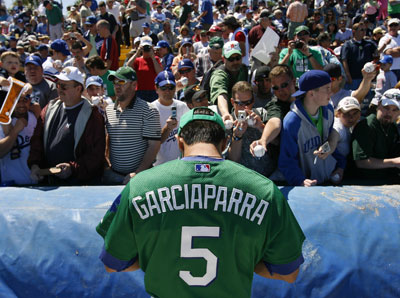
I was sitting beside my six year-old son on a grassy hill in deep left field during the late innings at a Dodgers-Red Sox spring training game in Vero Beach, Florida. I noticed #5 of the Dodgers signing autographs next to the wall beside first base. I recalled how powerless I felt when, on the plane to Florida, my son said his main goal of this special trip was to”get Nomar’s autograph.” I wasn’t sure how long Nomar had been signing – would he quit in ten seconds? – and the pack of fans around him was large. I knew that if I pointed out Nomar to my son and then he failed to get an autograph, he would be crushed. I knew that if I didn’t tell my son about Nomar being over there, he wouldn’t notice and our pleasant day would continue, undisturbed. Looking across the vast stadium at Nomar, I calculated the chances of getting his autograph at about 10%. WHAT WOULD YOU HAVE DONE?

I decided 10% was high enough to give my son’s dream an outside shot. I pointed out Nomar to my son and asked if he wanted to run over to the other side of the park, emphasizing that Nomar might stop signing any second. “Yeah Daddy, let’s go, NOW!” And we started running. (Insert Mission Impossible theme song here.)

When we got to the top of the aisle leading down to the wall where Nomar was signing, we saw that the crowd of fans around him was about fifteen people deep – 80% of them adults. It was a pseudo-line, yet it was obvious that the people at the back of the pack would stay at the back of the pack and go away disappointed. WHAT WOULD YOU HAVE DONE?

I decided to teach my son how to get an autograph. “Listen,” I said, “If you want Nomar’s autograph, go down there and slither like a SNAKE to the front of that pack, then stick your glove right in front of Nomar’s belly button. Do you understand?”

“But Daddy, that’s cutting,” he said. (What a good boy.) It was time to teach him about the cutting exception.

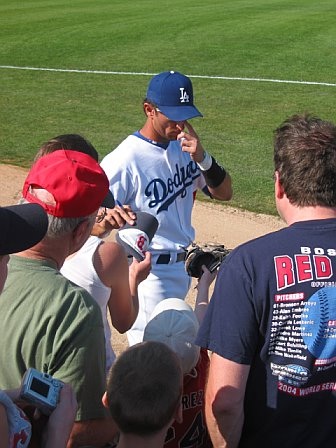
“It’s not cutting when you’re a kid and all those people are grown-ups,” I explained to him. “Nomar wants to sign autographs for kids, not fathers. Nomar WANTS YOU to slither to the front of the line. All kids slither to the front of theNomar at spring training, 2006 pack, and that’s OK. That’s the law of autographs,” I explained. “Now GO.”

And off he went. Slithering better than a snake could slither. I don’t think he touched anyone on his way to the front, right in front of Nomar, where he thrust his glove towards Nomar’s belly button (see left). Nomar handed a hat back to a girl, adjusted his sunglasses, looked at the outstretched arms before him, smiled at my son, then took his glove and signed it with his blue Sharpie.

A MIRACLE! A boy’s impossible spring training dream come true. I wish I could describe the look of wonder he had his face. Although that autograph has almost completely faded from my boy’s ragged glove, the memory will always be vivid. (And Nomar remains one of my favorite four athletes of all time.)

20 Presidents at Game On!

Rob, Robert, Caroline, Erin, EmmaAll of us who attended the Red Sox Nation Presidential Campaign Event at Game On! last night had a lot of fun. The event featured three-minute platform speeches from 20 of the 25 “finalist candidates” who were able to attend, and was hosted by Hazel Mae and Dr. Charles Steinberg.

While singing I’m A Member of Red Sox Nation with my son, niece, and friends, Big Papi cranked a triple vs. Tampa Bay on the large screen TVs (nope, those cheers from the crowd were not for us). The platforms and personalities of the candidates were incredibly diverse, yet when we all got up on stage together to sing “Sweet Caroline” at the end of the night, there was not a shred of competitiveness in the room. Slapping each other on the back, we all knew we were in the company of family members we just hadn’t met before. We were all related in a way that reached to the core of our identities. It was like meeting long lost brothers and sisters, all of us sharing the same genetic neuroses, the same obsessive passion for baseball, the Red Sox, and Fenway Park.

It was a privilege to share the stage with Hall of Famer, Peter Gammons, and I enjoyed meeting Sam Horn, who is a truly classy guy and gave a rousing speech. And 18 year-old Will French, born in Connecticut and now living in Rye, New York, stole the show with his raw humor. Pretty much the only thing missing at the event was negativity, which made it feel strangely un-Red Soxian. Is this what it feels like in Anaheim sports bars?

If I were running this thing, I’d end the campaign now and appoint all 25 finalists, or hold an election to solidify a group of 10-15 “presidents.” Multiple presidents could serve the fans, and the Red Sox, much better than one person could. “President of Red Sox Nation” has a nice ring to it, but given that the Nation isn’t a government and doesn’t really need a single decision-maker, wouldn’t everyone benefit more from a group of RSN presidents reflecting all kinds of RSN diversity and points of view? I’d hate to lose the sense of shared purpose, enthusiasm, and camaraderie we started to cultivate on Tuesday night. And how can Rem Dawg, Peter Gammons, and Sam Horn NOT have a role in this first “administration?”

(photo by Flo Farrell)

Stage 5: Home is Where The Red Sox Are Playing

TBCC at Camden Yardshe following article was written by my brother, Benjamin Crawford (left), the greatest Red Sox fan I know, who lives with his family just outside Washington, D.C. He liked my “four stages of Red Sox fan evolution” but felt that HIS stage was missing…

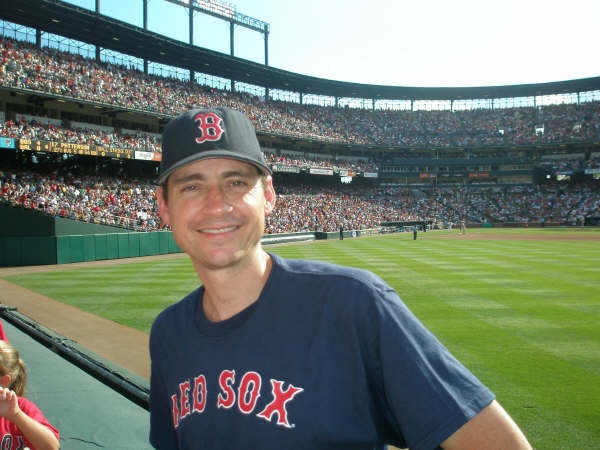
Stage 5 is the stage where you move away from New England and Fenway, lucky to see the place even once a year, yet still impart the fandom to your kids…and, in my case at least, wife. This is the stage that a large number of the 40,000 fans at Saturday night’s game in Baltimore come from….and my sister’s family in Allentown, Pennsylvania….and of course, me. We highlight the days on our calendars when the Red Sox will be playing at a stadium within driving distance…we travel five hours with our small children to see the Sox play an exhibition game…..we teach our kids that the blue hat with the red “B” (and, of course, the red hats with the B and the green hats with the B and the pink hats with the B) is the one we root for, despite being surrounded by “W” hats or O’s hats or, in many cases, the dreaded interlocking NY. We miss work (don’t just go in late) to fly around the country to see the Sox play in the postseason. We read the Globe and Herald every day online….even in January. And when we read the Globe, we wish Peter Gammons would go back to doing what he does best, the Sunday notes, and stop his ESPN gig. We teach our kids to sing “root root root for the RED SOX” during Take Me Out to the Ballgame. We cover the walls of our basements with pictures of Fenway, and old timers in Red Sox hats (in my case it’s autographed photos of Ellis Burks and the immortal Butch Hobson). We hang Red Sox/Fenway stuff in our offices…prominently. We stand out as Red Sox fans.

Fenway Park is a place we only see on our TVs (many people in RSN, in this stage of fandom, panicked when it appeared that DirecTV would be the sole carrier of MLB extra innings) and hear through our radios (thank you, MLB.com!). Our Red Sox experiences these days are in far away ballparks. With that in mind, we revel in walking around a visiting ballpark and seeing the people who make up Red Sox Nation, and of course their Red Sox paraphernalia (evidence that there really is an article of clothing out there for everyone). With a mix of amusement and pride, we laugh as the home fans get increasingly annoyed as they look around and see themselves surrounded…and drowned out…by Red Sox fans. We giddily discuss the vagaries of this year’s squad with our neighbors in the stands…because we can. Where I work, nobody cares about whether Dustin Pedroia is leading off or hitting second. But these people do. My neighbors don’t care that Francona went with Delcarmen instead of Okajima in the eighth inning in a game RSN at Camden Yardsthe previous week…but these people do. It’s our cross to bear and our badge of honor to overanalyze every minute detail of the team.

Perhaps more than anything, we get goosebumps when we hear a non-Fenway stadium rise up in chorus, “Let’s go Red Sox” (and are pleased to note the beautifully harsh Boston accent…”Sawx” instead of “Sox”).

My college roommate, Mike Mahoney, grew up a member of the Nation on the coast of New Hampshire. He left New England eight years ago to take a job in Chicago, and since then has moved to Philadelphia. By his own admission, he hasn’t been to Fenway in years. However, by his count he has seen the Sox play in both Chicago stadiums, Milwaukee, Philadelphia, Baltimore, Yankee Stadium, Busch Stadium (Game 4…he was there!), and Seattle. This is what he has to say about stage 5:

“I have good friends who are still in New England, and of course I am jealous of them when they go to Fenway. But I also love calling them when I am in a ballpark somewhere else and I know they’re back home watching on TV — jealous of me. And I tell them that there is no way to fully understand the power of Red Sox Nation until you’ve seen it in another ballpark. It is one of the most amazing things I’ve experienced, and it is probably the thing that makes me prouest of where I grew up. It really is an identity. To be honest, I look forward to getting the schedule each year now because I see it as an opportunity to visit a new place, using the Sox as my excuse. Because no matter what city you are in, if the Red Sox are in town, it feels like home.”

“I sometimes watch the Red Sox players in other ballparks and wonder how they view this, if they ever talk about it with each other. Even more, I watch FORMER Red Sox players who are now on the other side…a guy like Millar with the Orioles…and I wonder if they have more of an appreciation of their days in a Sox uniform. It really is a traveling carnival. As an Oriole, Millar will play the Blue Jays or the Devil Rays in front of about 10,000 fans. When he was a member of the Red Sox, every game in every stadium was a sellout…and most of the people were there to see him and his teammates. What an amazing thing!”

The Birth of a Believer

young Sox fan

Below is another article in a series of blog entries I’m writing as a candidate for president of Red Sox Nation. 

My eight year-old son is a believer. In his short life, he has attended some of the greatest regular season Red Sox games of them all. He was at Fenway for the Varitek-ARod fight followed by the Mueller walk-off vs. Mariano Rivera in 2004; he was there for the Mark Loretta walk-off home run vs. Seattle on Patriots Day in 2006; and he was there for the incredible six-run, ninth inning rally vs. Baltimore on Mother’s Day earlier this spring (Sox won, 6-5).

He was also there for the 14-0 loss to the Braves in May. It was at this game that I realized he has become a FULLY EXPECTANT BELIEVER in the Red Sox.

The weather was horrible. By the end of the 7th inning, with the Braves leading 11-0 and a steady downpour soaking Fenway, only a few thousand fans remained in the stands. My son was shivering so I asked him if he wanted to head home. “No way, Daddy!” he said, insulted. “Daddy, we’re going to come back and win this game.” Then he commanded, “Put on your rally cap!” So I turned my cap inside out. And so did all the people sitting near us.

In the 8th inning, completely drenched, he turned to me again and said with absolute seriousness, “Daddy, the Red Sox are winning this game.” I replied, “I know they are.” In the top of the ninth, the Braves scored three more runs, and before the Sox came up in the bottom of the ninth, he said, “That’s actually good, Daddy, because now the comeback will have three more runs and that will be more exciting.” “You’re right,” I replied. “LET’S GO RED SOX!” he continued to yell through the raindrops. The Sox went one-two-three in the ninth, and the worst Sox game of the year (from a spectator’s perspective) was over. My son was pensive as we walked out of Fenway.

On the drive home, he was quiet and I thought he was asleep until he said, “Daddy, I know this sounds strange, but I’m going to say it anyway. I really think it’s…. funny that the Red Sox didn’t win. I mean, I really really thought they were going to come back. Even with two outs in the ninth inning, I just knew they were going to win.” Then, he fell asleep. His earnest faith gave me goosebumps.

How lucky am I to be this boy’s father, and to be raising him a few miles from Fenway? How lucky is Red Sox Nation to have this kid as a citizen?

Evolution of a Red Sox Fan: Stages 3 and 4

Below is another article in a series of blog entries I’m writing as a candidate for president of Red Sox Nation.

My last article discussed stages 1 and 2 of the four stages of evolution of a Red Sox fan. Now, it’s time to take a close look at stages 3 and 4. As I said earlier, no stage is better or higher than another (indeed, I wish I’d stayed in stage 1 forever) and all fans at all stages are equal in their Red Sox Nation citizenship. (Did you go through a stage that could be described differently? I’d love to hear about it.)

Stage 3: Prioritization, Re-calibration, Sacrifice Stage 3 is the hardest one to enter, because it requires a complete overhaul of one’s habits and values regarding focus on baseball. This is the stage when we learn how to integrate our passion for the Red Sox with our desire for solid, long-lasting relationships with people who don’t share our Red Sox obsession. Some consider stage 3 to be evidence of fan regression, not evolution. (I do see their point.)

When our spouses, significant others, and children (who, although we love them, are occasionally “significant interruptors”) request our undivided attention when the game is on; when we’re absorbed in the pages of the Sunday Globe or Herald; when the World Series pre-game show has just begun; when we’ve got tickets and we’re running out the door — we are facing a stage 3 moment. In this stage, a Red Sox fan can either take a deep breath and calmly engage with the significant interruptor, or cling to the die-hard-fan mentality, blow-off the significant interruptor, and strain or destroy his/her relationships. A genuine stage 3 fan has learned to manage his expectations about how much time he will be able to spend “being an active fan,” and recognizes the moments when he’s torn from his fan experience as “critical relationship-defining junctures” and “necessary baseball sacrifices.” Every fan who enters stage 3 and re-calibrates his priorities is destined for long, contented interpersonal relationships, a degree of baseball starvation, and a dependence on Tivo.

I had a stage 3 moment last Tuesday night after my wife and I had finished putting our four children (ages 8 to 1) to bed. While enjoying the fifth inning of the Sox-Orioles game on NESN, one of the four kids woke up, came downstairs, and asked me if she could watch a Dora The Explorer video. (She had fallen asleep at 5:00pm and we were hoping she’d sleep through the night…) The stage 2 fan in me felt a twinge of resentment and even wanted to say, “Nope, sorry darlin’,” and just endure the little girl’s woeful sobs. But the stage 3 fan in me won out, and 30 minutes of Dora’s Pirate Adventure ensued. I was proud of myself. For my “evolution.”

ballplayers in the outfieldStage 4. “I am one with baseball.”A stage 4 fan is one who, with an endless archive of Red Sox memories, has developed a philosopher’s appreciation of The Game; whose passion is ignited by the way a third baseman kicks the dirt between pitches; who knows the Red Sox will win another World Series in his/her lifetime, and it won’t be because of a particular managerial move or trade, but because the stars align and the players get on a roll; who sees baseball as a metaphor for numerous truths and paradoxes of the natural world; who can thoroughly enjoy watching any major or minor league team play, and indeed, can get as much enjoyment from watching a local little league game as from a Red Sox game; who reveres a slick-fielding, reliable shortstop with superior range (regardless of his ability to hit) as much as a dominant closer or triple-crown contender; whose number-one reason for not wanting to miss an inning of any game is the fear that something will happen, the exact nature of which he’s never seen before; who understands completely that the Red Sox are a business, but who still sees the magic in baseball and the majesty of Fenway Park; who is grateful for the chance to watch Derek Jeter play, even though he’s a Yankee; and who is deeply moved by baseball’s unparalleled capacity for enchantment, particularly in the hearts of children, and is on a quest to recapture his/her own innocent, child-like appreciation for the game (stage 1).

Stage 4 is sort of like becoming a baseball buddha. Of course, stage 4 encompasses all the other stages, because the stages are cumulative to some degree. But at the same time, stage 4 is absolutely distinct from the other stages. And by the way, only those of us who were fans in 1918 were able to access stage 4 prior to the last out of the 2004 World Series. (Now, we all can.) Perspective, appreciation, and sagacity are impossible when you’ve only experienced heartache your whole life and you actually wonder if curses are real.

Being the father of an 8 year-old Red Sox fanatic has launched me into the realm of stage 4. While my love for the Red Sox remains very personal, the most joyful aspect of my fan experience involves my oldest son (the other three haven’t caught the baseball bug yet). I am re-living stage 1 through him, and loving it even more this time around. I have witnessed first-hand how baseball has led my son to dream big dreams and believe anything is possible; how baseball fills his afternoons with hour upon hour of serious play; how being at Fenway engrosses him and engages his imagination in spectacular ways; and how Red Sox baseball has become essential common ground in our very close father-son relationship, ground to build on for years to come. (And now, I understand how much fun my parents had with me and my three siblings when we were stage 1 fans.)

Are you a stage 5 fan? If so, let me know what’s in store for me. Many, many thanks…..

Evolution of a Red Sox Fan: Stages 1 and 2

Below is another article in a series of blog entries I’m writing as a candidate for president of Red Sox Nation.

I’m a different Red Sox fan now than I was as a kid, and before I had kids, and before 2004. Is it possible that all Red Sox fans go through an evolutionary process? I’ll go on the record asserting that there are four distinct stages in the evolution of a serious Red Sox fan (at least, there have been four for me). No stage is necessarily better or higher than another (indeed, I’m striving to return to stage 1), and all fans at all stages are equal in their Red Sox Nation citizenship. Here’s how I’d define the first two stages.

Stage 1. Discovery, Innocence, OptimismThis is the stage in a Red Sox fan’s life when he/she is awakened to the existence of the Red Sox and Fenway Park, and when everything about the team is joyful and thrilling. (Stage 1 fans could be six year-old children, or college students from outside New England, for example.) People in this stage have feelings for the team that resemble a very intense crush. They have a favorite Sox player whom they idolize, treasure the Sox posters in the Sunday Globe, and cannot conceive of a scenario where the Sox fail to win the World Series this year (they are overflowing with hope.)

For me, this stage began in about 1976 when I was in second grade and it continued through high school and the 1985 season. I kept a few journals for school during these years, and half of my entries focused on the Red Sox and the Sox-Yankees rivalry. All entries were cheerful. The journal entry I wrote the day after Bucky Dent’s homer in ’78 (I was ten) hints at more melodrama than pain. My eight year-old son is in stage 1 now, and I pray for him that it lasts as many years as possible. These are the wonderful years of baseball innocence.

Stage 2. Identity, Obsession, Vulnerability This is the stage of the “die-hard” fan. These fans have several emotional Red Sox memories (or scars), and their excitement about the Red Sox has blossomed into a full-fledged addiction. They cannot miss a game. Or even an inning of a game. People in this stage throw their souls at the mercy of the Red Sox’ fortunes. They experience unparalleled euphoria when things are going well, but are vulnerable to deep depression when the team disappoints. Every win or loss is taken personally and somehow reflects their own self-value. Some fans choose to never leave this stage, and we admire them for that.

For me, stage 2 began when I went to college in New Hampshire and was surrounded by people from all over the world, but mostly from New York and New Jersey. The Red Sox served as the core of my identity. I felt like a full-fledged member of the team. I would travel very, very long distances, stand in long lines (even overnight), pay money I didn’t have, and change any long-standing plans (such as participating in a relative’s wedding) to watch them play in person. Like I say in my song, it’s a kind of insanity. (Most fans in stages 3 and 4 re-enter stage 2 when the Sox play the Yankees, or are in the playoffs and World Series.)

Coming soon, the definitions of Red Sox Nation citizens in stages 3 and 4 of their fan evolution.

The Accidental Major League Tryout

Below is another article in a series of blog entries I’m writing as a candidate for president of Red Sox Nation.

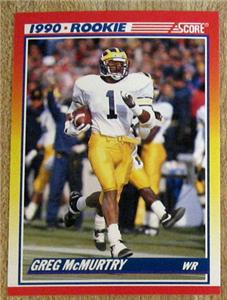
I was a Greg McMurtrymediocre pitcher for Brookline High, a 130 lb. reed with infinitely more heart than talent. Greg McMurtry was the stud of the the state champion Brockton High School squad, the future Michigan Wolverines legend, #1 draft choice of the Boston Red Sox, and third round choice of the New England Patriots. In the spring of 1986, for six pitches, the divergent paths of our baseball careers crossed. It’s funny how vividly I remember that encounter, like a movie I’ve seen a thousand times…
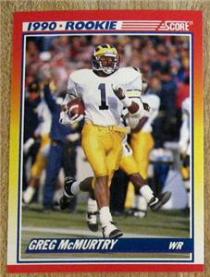
The day was May 16, 1986. I was playing left field and Brockton’s lead was something like 19-3. Major league scouts perched along first and third baseline fences, waiting for another glimpse of McMurtry’s majesty. I and the rest of the players there that day hungered for a chance to do something heroic in front of the scouts, to begin our dream-like march to the bigs and the Baseball Hall of Fame. But by the sixth and second-to-last inning, it didn’t look like I was going to get that chance.

Then, the first three or four Brockton hitters reached base to start of the bottom of the sixth inning, so I was summoned to the mound to quash yet another Brockton rally. I remember trotting in from left thinking, When is McMurtry coming up? As I threw my warm-up pitches, I overheard a scout ask my coach, “What’s this new guy’s name?” The last few warm-ups were the hardest fastballs I had ever thrown.

The first batter I faced waved his bat at three smoking fastballs, missed them all, and sat down. Holycrap, I thought, I just wasted that guy in front of twenty major league scouts. I’m gonna be a pro! As I watched the next Brockton player step into the batter’s box, I heard some scouts buzzing. One, in an Astros cap, help up his radar gun and pointed it at me. I was being noticed.

The next batter watched the first two fastballs tear by him for strikes, fouled off a curveball, then swung mightily under a high heater for strike three. I tried to baseball radar gunstay calm. OhmyGod. I’m blowing away the best hitters in the state and twenty major league scouts are watching. I looked over at my father. He was beaming and talking with a rotund man in a Dodgers cap who was holding a clipboard. I’m gonna be a Dodger!
The next batter stroked my first pitch to right field, a clean, line drive base hit. No problem, they’ll forget about that when I nail this next guy. But I walked him. And the next batter singled, loading the bases. And as another Brockton batter walked to the plate, I saw the marvelous figure of Greg McMurtry swagger to the on-deck circle.

He carried a black bat with a red donut on it and stared at me, calm but fierce, like a panther patiently eyeing a rabbit he wants to maul. Relaxed, he swung his bat one-handed over his left shoulder, then switched hands and over his right shoulder, showing beautiful, hard muscles like in a Michelangelo sculpture. I forced myself to avert my eyes and focused on my catcher, looking for the signal.

I knew I would fail to retire this batter. That McMurtry would come to the plate seemed inevitable. I could feel the two of us being tugged toward confrontation by the strings of fate. (I seriously doubt Greg felt the same thing.) Sure enough, the batter preceding McMurtry hit a ground ball that squeaked through the hole between the third baseman and shortstop. A couple of runners scored, and Greg McMurtry stood at home plate to give them high-fives.

The scouts adjusted in their lawn chairs and pointed their video cameras towards the batter’s box. McMurtry stepped to the plate with the confidence of a superhero. Sweating and trembling, I faced the awesome challenge standing sixty feet, six inches before me.

The catcher put down two fingers, signaling a curveball. Good idea, he won’t expect that. High, ball one. I was relieved I had survived the first pitch and I relaxed a little. Again, the catcher called for a curveball. Ingenious idea, he certainly won’t expect another curveball on a 1-0 count. High, ball two. The catcher tossed the ball back to me as the scouts moaned, worried that I would give McMurtry nothing good to hit and issue him a walk.

Hold on a second, this is Greg McMurtry. Don’t play around with him, I scolded myself. This is your chance for glory, the moment you dreamed of in every wiffle ball game growing up. Wake up and go after him. For Godsakes, don’t walk him! I realized I had made an error of, perhaps, historic proportions in the annals of the Crawford family.

Looking in for the catcher’s signal, I got the sign I wanted, a single finger, then I blazed a fastball over the outside corner. “Stee-rike!” yelled the ump. Suddenly, I had a shred of self-confidence. The count was two and one. I had to throw another fastball. I knew it, my catcher knew it, and Greg knew it. I threw the heater, this one with extra juice, right down the heart of the plate. McMurtry coiled then swung majestically and we all held our breath for an instant. Thwack! The ball met the catcher’s mitt and Greg McMurtry, for the first time all day, was mortal, stumbling momentarily to regain his balance after a frighteningly robust swing. “Stee-rike two!”

Holycrap, I’m one pitch away from striking out Greg McMurtry in front of twenty major league scouts. I looked over at my coach. He was pacing and smiling, arms crossed, savoring the possibilities of the next pitch. “Go get him, Robby!” he said. “One more, one more, kid!” I looked at my father. He smiled at me, winked, and pumped his right fist. With his left hand, he wiped the sweat from his forehead. I looked in for the sign. McMurtry leaned in a little more over the plate to protect the outside corner. The perspiration on his steel forearms glistened in the sun. The catcher put down a single finger and I threw the ball as hard as I could. McMurtry stepped into the pitch but held his swing. Outside and low. Ball three.

“Full count!” bellowed the umpire, who was obviously auditioning for the majors, as well. I got the ball back from the catcher and closed my eyes. Please God, don’t let me walk him, don’t let me walk him. I glanced over at my dad. He and the Dodgers scout were chuckling, the scout carelessly and my father nervously. Our eyes met and his seemed to say, “Oh boy, Rob, you’ve really gotten yourself into a situation here!” McMurtry started at me. I could tell he wanted a chance to show those scouts that his futile swing had been a fluke. He wanted to take me deep.

The catcher didn’t even bother with a sign. It was fastball all the way. Just hum it in there and see what happens. I looked at the mitt and tried to focus. I tried to block out my teammates, the scouts, my coach, my father, even Greg McMurtry. I tried to block out the full count and the fact that the next pitch would be remembered and talked about in my family for years to come, regardless of the result (and it has been!).

Then, pulled along in the current of time and fate, I wound up and delivered my pitch, a fastball that I tried to guide with my will as it approached home plate. The scouts watched, my father prayed, my coach grinned, and Greg McMurtry checked his swing as the ball crossed the outside black of the plate. “Ball four,” said the umpire non-chalantly, rising from his crouch. I shrugged as McMurtry glided toward first base. He proceeded to steal second before one of his teammates flew out to end the inning.

I walked Greg McMurtry.

That summer, the Red Sox drafted him in the first round, but he chose college instead and starred for Bo Schembechler’s Rose Bowl-winning Michigan Wolverines for four years. He was drafted by the Detroit Tigers (27th round) and New England Patriots (3rd round) in 1990, and played wide receiver for the Patriots and Bears for five seasons, during which he had 128 receptions for 1,631 yards and five touchdowns. He was out of major pro sports at the age of 27.

I never saw another athletic moment as important or dramatic (to me) as my 3-2 pitch to Greg McMurtry. That day, that situation, was the closest I ever came to my dream (and every kid in Red Sox Nation’s dream) of being drafted by the Boston Red Sox. Greg McMurtry wouldn’t recognize me if I walked right up to him and introduced myself. But the image of his chiseled body, his confident glare, and his one elegant, lusty whiff at a Rob Crawford fastball will be with me always.

A Meaningless JV Baseball Game, a Timeless Memory

Below is another article in a series of blog entries I’m writing as a candidate for president of Red Sox Nation.

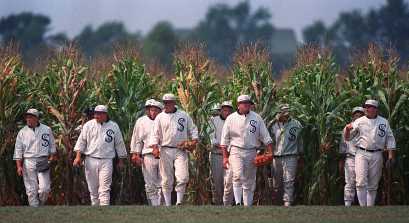
Before every little leaField of Dreamsgue game I coach, I remind myself that what’s about to unfold on the field might be forgotten by me and other spectators within a day, but that for one or two of the kids playing that day, something might happen that will be carved in their memories forever. The memory might be marvelous (home run), and it might be torturous (bonehead error), but it will endure in the player’s mind the rest of his days. If you ever played organized baseball at any level growing up, you know what I’m talking about.

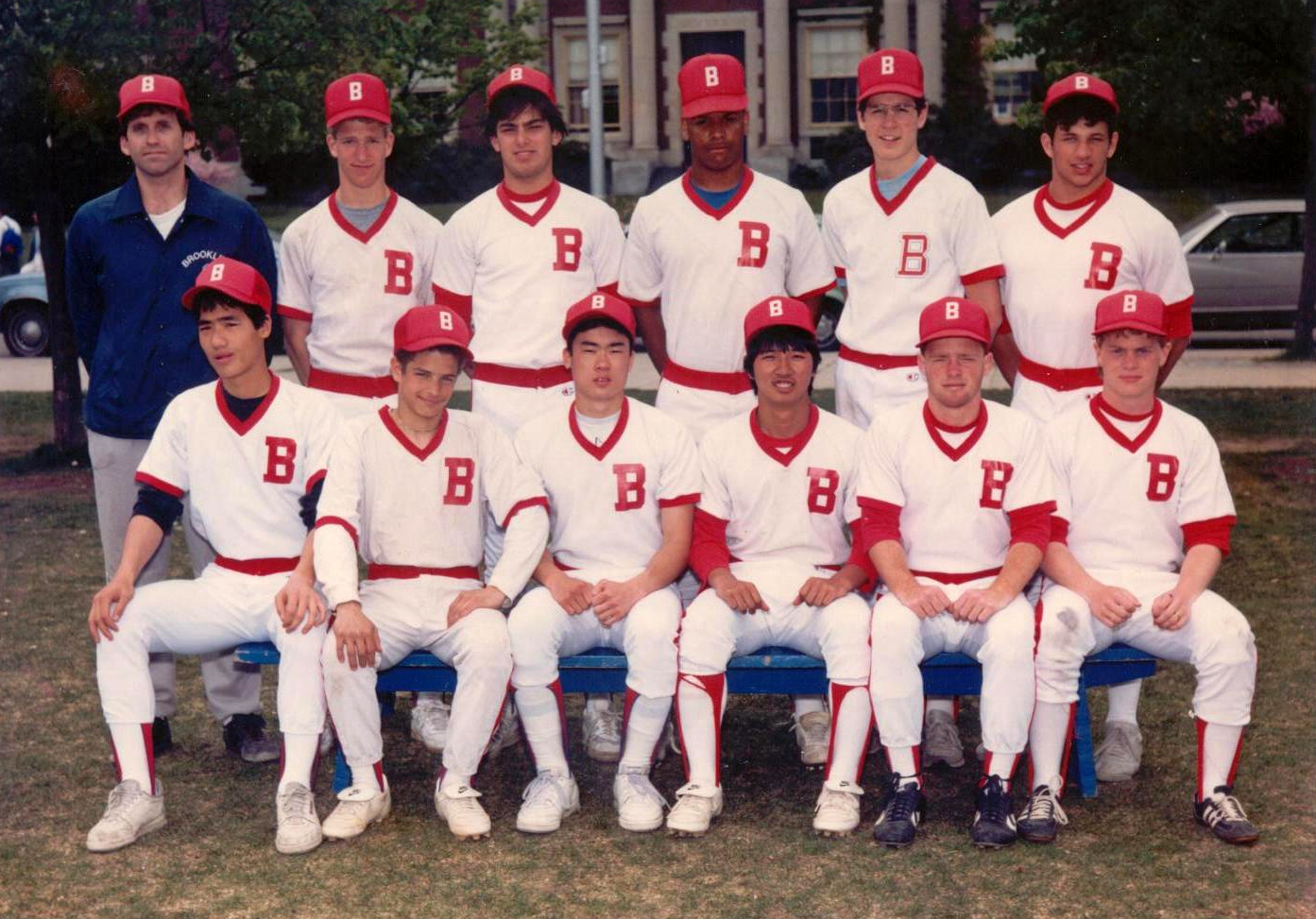
One of those baseball memories I’ll always carry around is of a game that took place my sophomore year in high school, in 1984, as a member of Brookline High’s JV baseball team. I was a skinny kid with a decent glove and strong throwing arm, but no bat. I was either the last or second-to-last player to make the team (and I still have the stubby stick I picked up off the ground and rubbed like a good luck charm as Coach Cohen read the names of players he was keeping on the last day of tryouts), and I knew I’d see very little playing time that year. That was OK with me. I was happy just to wear the uniform, to go to baseball practice after school every afternoon, and to sit on the bench with the guys, munching sunflower seeds and talking baseball.

Little did I know I wouldn’t see any game action until midway through the season, and that when I did finally play, the game’s outcome would depend on my individual performance. That moment came on a wet, overcast afternoon at Amory Field in Brookline, which is located just off of Beacon Street, about a half-mile from Fenway Park. It was the top of the last inning, we were ahead of Waltham High by one run, and they were batting with two outs and the tying run on second base. A beefy left-handed hitter approached the plate as I blissfully played catch with another sophomore behind the bench.

“Crawford!” rang Coach Cohen’s voice. I was jolted by the sound of my name and it took a full second for me to realize the coach needed me to do something. Pick up the helmets or straighten the bats, I assumed. But there was urgency in his voice. Brookline High School JV baseball team 1984“Crawford! Get in there for Jeff in right field. His arm’s sore. And if the ball comes to you, throw it home!” I grabbed my glove, pulled my hat on tight, and glanced over at my father, standing in his usual place behind the backstop. He smiled, winked, and pumped his fist, communicating wordlessly his faith and encouragement.

I sprinted towards right field, imagining myself to be rocket-armed Dwight Evans. “Two outs, Rob!” said Justin Walker, the second baseman, as I chugged by him. (Justin, front row, second from the left, later went on to an acting career and had a major role in the 1995 movie, Clueless. By some amazing coincidence, that BHS JV team’s first baseman, Joe Reitman, back row, far right, next to me, also went on to an acting career and also appeared in the movie Clueless.) It wasn’t until I reached my post in right and turned to face the diamond that I realized the dreadful mistake I had made before taking the field.

As I peered towards home plate from my unfamiliar post in right field, everything looked foggy. I blinked, but the fog remained. Suddenly, my heart stopped. My God. I forgot to put on my glasses. The reality of my plight spilled over me like icy water. My saliva tasted metallic and my legs wavered. I was too embarrassed to call time out. Oh God, please let that big lefty hit the ball to someone else. Please God, I begged silently. But God had already finalized his plans for that big left-handed hitter, the baseball, and me.

The big Waltham kid swung at the first pitch. Ping! The ball shot up into the sky and, to my horror, it entered the air space above me. All eyes turned to me as I jerked forward, believing the hit to be a shallow bloop. But three running steps forward and a new perspective on the white blur above me revealed a drastic error in my calculations: the ball had been socked, not blooped!

baseball catchTrying to change direction, I slipped on the muddy turf and fell to one hand and one knee. But I kept my eye on the hurtling white puff and bounced to my feet. Back, back, back I stumbled until I hit another wet spot and lost my balance. I fell backward, with my glove arm outstretched. Then, at the same moment I landed flat on my back in the cold, muddy outfield – plunk – the ball fell into my glove, Red Sox win!and I squeezed.

Rising to my feet, I held the ball proudly above my head, showing the umpires, my teammates, my coach, and my dad that I had caught it. We had won. Within seconds I was mobbed by my screaming, disbelieving teammates. What a moment! My father, who retells this story every time our family is together, recalls that, as Coach Cohen walked over to the Waltham coach to shake hands, he put his hat over his face as if to say, “Did we just see what we just saw?”

What does this story have to do with Red Sox Nation? Maybe something about how we all wonder how we would perform under the same pressure our Red Sox heroes face regularly. Or maybe it’s about the snapshots we all carry around about our own triumphs and failures. Or how the Red Sox bring out the dreamer in all of us. I don’t know. Maybe you do.

Slammin’ Scott Hatteberg ushers in “My Life, Part 2”

Below is another article in a series of blog entries I’m writing as a candidate for president of Red Sox Nation.

I’ve written before on this blog about my open heart surgery in 2001 to repair a ruptured sinus valsalva aneurysm. What I haven’t written about is the role that baseball, the Red Sox, and former Sox catcher Scott Hatteberg (below) played in the whole surgery-recovery experience.

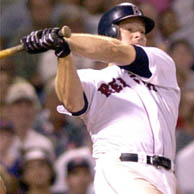
Scott Hatteberg grand slamEarly in the morning on August 6, 2001, lying on my back in a hospital and nervous about having my chest sawed open, I was wheeled into an operating room feet first. I recall looking up at the room number and suddenly feeling totally comforted about the outcome of the surgery. Why? It was room 37. That was my uniform number during the ten years I pitched for Avi Nelson Club in the Yawkey Amateur Baseball League of Boston. I just knew that was a sign. A good sign. (Hey, even us amateur baseball players never lose our superstitions….)

Fast-forward about 15 hours to 9:30pm. The successful surgery had been completed by noon and I had been unconscious in the intensive care unit all afternoon and night. My wife, pregnant with child #2, had gone home to put our two year-old son to bed and my parents were sitting by my side, watching the Red Sox-Rangers game on the TV, waiting for me to wake up from my drug-induced haze. The doctors had told them I would probably open my eyes by midnight. Exhausted themselves from a long day at the hospital, my parents finally decided to go home too – but before they left, they asked the nurses, “Please don’t turn off the TV. If Rob wakes up with the Red Sox game on, he’ll be happy.”

Now, shift to my perspective. This is what I remember as I regained consciousness: I began to open my eyes, the room was dark except for the glowing TV, and the commentator was yelling something: “… long drive, way back, GRAND SLAM SCOTT HATTEBERG, and THE RED SOX TAKE BACK THE LEAD!”

At the precise moment I woke up from my surgery and realized I was still alive, Scott Hatteberg hit a go-ahead grand slam, sending Fenway fans into a delerious frenzy. I was all alone in the room at that moment – just me, Scott Hatteberg, and the screams of the Fenway Faithful. Needless to say, I was pretty emotional as I lay there in my bed — out of gratitude for a “second birth” and also moved by the in-your-face-baseball-joy playing out on my TV. I remember that my whole body was pretty sore, and I remember being simply amazed that that euphoric Red Sox moment was chosen for me to return to consciousness. It will always be one of my life’s most incredible memories.

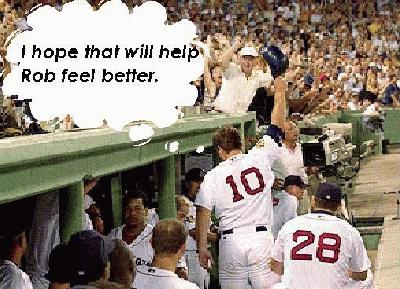
Hatteberg’s slam came in the bottom of the sixth inning, following the Rangers’ demoralizing five-run fifth inning, and neither the Red Sox nor the Rangers scored any more runs the rest of the game, resulting in a 10-7 victory for the Sox. (See box score here.) Interestingly, in Hatteberg’s previous at-bat in that game, he hit into a triple play, and his subsequent grand slam made him the first and only player in major league history to hit into a triple play then hit a grand slam in consecutive at bats. His bat from that game is on display at Cooperstown.Scott Hatteberg curtain call

Upon hearing this story of my dramatic “awakening,” one of my teaching colleagues, Matt Parke, now a basketball coach at Guilford College in North Carolina, doctored and then emailed me this photo of Hatteberg’s Fenway curtain call (right).

Someday, when Hatteberg (now a member of the Cincinnati Reds) is retired, I hope to meet him and tell him about how one of the best moments of his life was also one of the best moments of mine.

“I’m a Member of Red Sox Nation” — birth of a song

I have written a few Red Sox songs this summer. (I guess you could say writing baseball songs is a hobby — but the truth is, these tunes just come to me when I’m driving or hacking on my guitar.) One is called, There is Nothing Bettah, Than Beating Mariano Rivera. My kids like thakids bandt one. Another is called, On the Corner of Brookline Ave and Yawkey Way. This is the song I invited my songwriting friends, Dan Page and Michele Page, to come listen to about a week ago to help me write some lyrics. Just before they got to my house, the tune and first line of, I’m A Member of Red Sox Nation came to me. When Dan and Michele arrived, I didn’t even bother playing the Brookline Ave and Yawkey Way tune for them — I knew that the Nation song was the one we needed to work on. And we did.

It was a good time. We filled pads of paper with Red Sox images, phrases, memories, and ideas, referred from time to time to our thesaurus and rhyming dictionary, wrote and rejected about 250 lines — and a few days later, the song was complete. I stayed up late a few nights recording/engineering it on my iBook (using Garage Band software and the Mac’s built-in mike) in my basement, which is also my kids’ playroom. Surrounded by Play-Doh, dolls, and Pokemon cards, I perched the laptop on the surface of our air hockey table, and if you listen to the song carefully, you can hear our loud basement fridge droning in the background.

A week after the basement sessions, my good friends Bob Little and Michelle Rufo, along with about ten other day camp counselors at Summer@Park, taught the song to about fifty campers and organized them for an informal recording session in the lobby of the school’s gym. The kids’ enthusiastic singing was added to the last verse, along with their favorite Red Sox cheer, “Let’s Go Red Sox!”

The song was played at Fenway Park between the top and bottom of the fifth inning last Wednesday, July 18. If it has been played since then, I haven’t heard about it. Whether or not I’m elected president of Red Sox Nation, Dan, Michele, and I hope this song is good enough and gets enough play to get stuck in people’s heads across New England for years to come, making them smile every time they hear it. To read the lyrics, or to download the song for free, go here.

Dropped Back Into The Year 2007

PolaroidOne of the main reasons I am more passionate about parenthood and family life than most parents is that I experience family moments through the eyes of myself as an old man, or as though I’m watching current moments unfold forty years from now on a movie screen. Imagine how exciting it would be for a parent of grown adults to go back in time and re-experience some of his best days with his wife and young children. Imagine how precious every moment would be. That’s how I approach each day now, with my family.

When one of my children runs to me as I walk in the door from work, calls out “Daddy!” and hugs my legs, I record the details of that moment in my memory because I know it will be long gone in the snap of my fingers. When I’m driving and one of my children asks me a random question like, “Why did God give humans toenails?” it clicks in my head that this is a moment I’ll long for when my kids are grown up with their own kids, and I savor the ensuing conversation. When I’m reading bedtime stories to my children and part of me wants to be watching the beginning of the baseball game on TV, I simply remind myself that, when I’m 80, I’ll wish I could come back to this intimate, personal moment with my child, reading and discussing books at the day’s end. And then I experience the moment as though I’m reliving it, 40 years from now, reunited with my five year-old son before he became an adult.

Certainly, my heart surgery in 2001 intensified my awareness of the passing of time and the remarkable gifts embedded in each moment I spend with my family. But I have always possessed an acute appreciation of the present. I recall, at age 18 and 19, singing with my band and being aware of the fleeting nature of the joy I was experiencing on that stage. I recall, as a baseball player in my 20s, standing on the mound, gazing up at the lights towering above the field moments before throwing the first pitch of every game. I would memorize that view and that feeling of excited anticipation and express gratitude for the opportunity to compete and to excel.

I don’t know where or when I learned to see my life as though I had been dropped back into the present from the future. But I do know that this perspective is a spectacular gift that enables me to suck the marrow out of life while I’m here.

Swamped+Exhausted=Happy

climbing cliffI am swamped. Work. Family. Volunteer work. Creative projects. It’s a feeling of overwhelm that keeps me awake at night. There’s a fear that originates somewhere in my large intestine that whispers, “You can’t get it all done in a ‘good enough’ way – you can’t be everything to everyone you’ve committed to.” This is a level of busyness that can squeeze exercise, sleep, good eating, and thinking time right out of my life – for a period.

But I chose this. This is what I signed up for. Would I change my situation at work? No. We’re talking exciting, challenging projects with smart, interesting, talented people. Would I change my family situation? Are you kidding? I am blessed and my family is my greatest joy by far. Would I change my volunteer commitments? No way, I’m involved with great people at great organizations making a one-of-a-kind impact. Would I dump my creative projects? Well, these would be the easiest things to clear off my plate, but creative projects are the icing on the cake. Do I really want to scrape the icing off my cake? No.

The truth is, this feeling of overwhelm and exhaustion is a pure form of happiness. Winning the lottery wouldn’t hold a candle to this state of challenge, usefulness, connectivity, creativity, synergy, and struggle. This is what we live for. I’m in the middle of the soccer field with the ball rifling towards me and other players yelling my name. The game is on, baby.

The Cost of Praising Intelligence

It’s common sense that a good parent should frequently seize opportunities to tell his/her children that they are “smart,” isn’t it?

Not so fast.

Po Bronsoncub scout has written a fascinating article in New York Magazine, entitled, How Not To Talk To Your Kids: The Inverse Power of Praise. The article describes a recent study of 400 New York City fifth graders that shows that children who are repeatedly told they are “smart” shy away from challenges where there’s even a slight risk they might not succeed. On the other hand, kids who are consistently praised for their hard work or effort are more self-confident, more inclined to seek out challenging projects despite the possibility of failure, and less inhibited by concerns about how their work will be “graded” in the end.

Carol Dweck, the psychologist who led the study, writes, “When we praise children for their intelligence, we tell them that this is the name of the game: look smart, don’t risk making mistakes.” She continues, “Emphasizing effort gives children a variable that they can control. They come to see themselves as in control of their success. Emphasizing natural intelligence takes it out of the child’s control, and it provides no good recipe for responding to a failure.”

It turns out that teaching kids that their innate intelligence is the key to their success actually sends a damaging message to them by diminishing the importance of effort – which is, in fact, the ONLY thing over which they have any control!

Clearly, this study is hugely important for all parents, teachers, and coaches. And it reminds me of two baseball t-shirts my oldest son owns. One says, “Just give me the ball and let me do the rest.” The other t-shirt says, “Champions are made in the off-season.” One motto emphasizes ability, the other practice and effort.

I never did like that “give me the ball” t-shirt, with its arrogant, anti-teamwork, talent-focused slogan. And now that I’ve read about the impact of highlighting effort,  I love that “champions” t-shirt all the more!

(By the way, the cub scout in that photo is not my son – I actually have no idea who that is.)

Sustaining “Pure” Self-Confidence

My most recent article over at Lifehack.org tells about the “life list” my 7 year-old son has been composing over the last couple of months – on his own. I stumbled across his list about a week ago (modeled after John Goddard’s life list), and it has led me to ponder the question, “What difference do goals make, anyway?”

I recall hearing a terrific quotation from David Allen about goals. He said: “The value of goals is not the future they describe, but the change in perception of reality they foster, and the change in performance they effect right now, inside of you.”

hell freezes over(Re-read that quotation… it’s a great one.)

I love that my son believes that anything he can dream is possible. I love that that’s his reality. (“It’s not over, Daddy,” he says frequently, when watching a sports event whose outcome seems obvious. “Anything can happen.”) His life list reflects his expectation that he will eventually fulfill his loftiest aspirations (whether this is accurate or not is irrelevant) and if David Allen’s quotation is accurate, today and tomorrow he’ll “perform” with the pure self-confidence that fuels all great lives.

My challenge as his parent is this: How can I help him sustain his self-confidence, optimism, and possibility-thinking and carry it into adolescence and adulthood?

(To read my original article, My 7 Year-Old Son’s Life Listclick here.)

The ONE Question to Ask Yourself

compass on mapOne of the greatest blog posts I’ve seen comes from Rajesh Setty’s Life Beyond Code. If you haven’t seen his “Quoughts” series (Quought = Question that provokes thought), you must check it out. Rajesh asked several influential thinkers, “What is the ONE important question a person should ask himself or herself in 2007?”

The questions he received are big doozies – the kind that unhinge us from our comfort zones and help us see our lives through a new lens. Here are a few samples:

“How can I be the person that I hope my children become?” (Harry Beckwith)

“What do I have to do to earn and deserve the key relationships that are going to get me where I want to go?” (David Meister)

“How can I help others attain a level of success greater than my own?” (Mike Sansone)

“What is the question whose answer would set me free?” (Peter Block)

“What do I care about enough to defend in conversation with people I respect?” (John Battelle)

“What would I do differently in 2007 if I had no fear?” (Steve Pavlina)

And here are a few quoughts I’d have shared with Rajesh if he’d asked me:

“When am I in the zone, and how will I double the time I spend in the zone in 2007?

“On January 1, 2008, what habit or routine will I wish I had established in 2007?”

“What project can I start working on now that could, conceivably, lead to my next career?” (A good question to ask even if you love your current career.)

Work-Life Balance: The Window Looking West

window overlooking oceanThe best train ride I’ve ever taken was May 17, 2002, from Boston to Philadelphia. I know this because that’s the date I wrote on the inside cover of Magical Worlds of the Wizard of Ads: Tools and Techniques for Profitable Persuasion, by Roy H. Williams – the book that mesmerized me for the entire trip. Perusing the book again last night, I came across a note I wrote in the margin on page 136: “The best advice on work-life balance I’ve ever read.” I’d like to share with you a shortened version of this classic, two-page essay, entitled, Look Out The Other Window. The entirety of what follows is in Roy Williams’ words.
“How do you leave all the cares of the office at the office?” my good friend Akintunde asked. “I’ve never been able to do it.”

Pointing to the east, I said, “Look out that window and tell me what you see.” Akintunde looked intently out the window and described in detail what he saw there. “Now look out this window,” I said, pointing to the west, “and tell me what you see.” Akintunde spent the next several moments describing an entirely different scene. I said, “That’s how I do it.”

When he said he didn’t understand, I pointed to a bare wall and said, “Tell me what you see.”

Akintunde said, “I see nothing but a blank wall.”

“Keep looking,” I told him. After a minute of watching him stare silently at the wall, I asked, “Are you thinking about what you saw out the window?”

“Yes, I am,” he laughed. “How did you know?”

“Akintunde,” I said, “if you will pour yourself into something that will occupy your evenings and weekends as completely as your job occupies your nine to five, you’ll find that you will soon be feeling less tired, less frustrated, and less stressed out about what’s happening at the office. The reason you can’t quit thinking about the office is because you’re going home each night and staring at the wall.”

Like most people, our friend Akintunde had been confusing rest with idleness. Rest is not idleness. Rest is simply looking out a different window. If you have a job, or anything else that you struggle with and worry about, you have a window that looks to the east.

But do you have one that looks to the west?

It’s not, “What do people think of you?”

I want to share with you the most powerful idea about human relationships that I’ve ever heard. It’s in the form of a question, and it’s from an essay by Harvard Business School professor, Thomas J. DeLong, in Remember Who You Are (2004). Here it is: “How do people experience themselves when they are with you?”

Imagine if, in our daily interactions with others, we succeeded in giving people a better experience of thegrandfather swinging grandsonmselves than at any other time during the day. 

This seems like an outrageously ambitious goal to set. But in practice, it doesn’t take much to achieve. Be excited to see other people. Look them in the eye. Smile with your whole body. Call them by name, and ask how they’re doing. When people ask how you’re doing, tell them, “Excellent!” Take an interest in others’ lives. Listen to their stories, and laugh. Keep conversation focused on them, not on you. By God, tell them how great they are!

How does your spouse or significant other experience him/herself when you walk through that door after a tiring day at work? Loved and appreciated? Or deflated? How does your child experience him/herself when he/she is with you? Are you more interested in watching the TV news than you are in hearing about his day at school?

Starting now, start to notice the “invisible” people in your daily life (such as administrative assistants, maintenance staff, fast-food order takers, security workers, and customer service phone reps) and deactivate their invisibility by asking a question, complimenting their work, saying a heartfelt thank you. Rid yourself of your hierarchical lenses and see others as equal to you – because they are! There’s something magical about giving someone a high-five and uttering their name with gusto as you walk by them in the hall. Try it!

DeLong prods, “What transpires inside people when you are talking to them? What are they thinking and feeling? In what way, however small, has their perception of themselves changed as a result of having the interaction?”

When we slow down and even go out of our way to make others feel unique, interesting, talented, or important, we are truly “making their day.” For that shining moment, their experience of themselves is ideal. (And, ironically, our experience of ourselves is idealized, too.)

Heart surgery’s lessons about the power of others’ attitudes

As described in my previous post, in 2001, at the age of 33, with one small child and another on the way, I was diagnosed with a heart aneurysm. And it had already burst. Slowly dying, I was scheduled for immediate heart surgery. In the previous post, I listed the main lessons about dying and living that this experience taught me. But there were other lessons – about the influence on me of other people’s attitudes during my time of greatest vulnerability.

1. There is incredible power in the support of friends, family, and acquaintances during a personal health crisis. Their cards, emails, calls, and visits – before and after surgery – are a secret weapon against the pernicious health threat. People I hardly knew wrote that they were praying for me. I was surprised at how much strength this gave me.

2. The professionalism and self-confidence exhibited by surgeons and doctors prior to surgery bring constant waves of calmness and humility that swell your soul with gratitude and awe. You realize that they are artists – craftsmen – whose hands and judgment are instruments of God. You have no choice but to surrender your life and your future to these strangers in white coats. And the act of doing so is humbling beyond belief, yet also freeing.

3. Likewise, nurses play unbelievably critical roles in recovery care. They are the angels who bring the necessary pain medicine at 2 in the morning, with a sympathetic and loving smile. Their incessant energy, enthusiasm, hopefulness, and optimism gets injected directly into your blood every time they walk into the room. When you are down, they are your heroes. The value to the world of a great nurse cannot be underestimated.

Clearly, my heart was fixed through the technical expertise of well-trained surgeons. Their mechanical actions – sawing open my chest, sewing up the tear, then putting my chest back together again – saved my life. But I believe that my physical and mental condition before, during, and after the surgery gave me the best chance for a successful outcome, and I know that it was the positive attitudes of the people I communicated with that week that put me in an optimal state.

Lessons from heart surgery on living and dying

storm approaching beachIn 2001, at the age of 33, with one young son and another on the way, I went to the doctor for a check-up and was diagnosed with a heart aneurysm. And it had already burst. Feeling perfectly fine but in fact slowly dying, I was scheduled for immediate heart surgery. I spent a week in the hospital, getting ready for surgery and recovering. A month later, I was healthy and back at work, albeit with a totally new outlook on my life and the lives of others. Since that surgery five years ago, I have said often, “I would wish open heart surgery for all my friends.” A strange wish, I know. But the lessons I learned from this medical crisis have enriched my life enormously. Here they are, sprinkled with five years of perspective:

1. You and I are going to die. Someday. My death is going to happen. Your death is going to happen. My wife and children are all going to die, too. It’s not a matter of “if.”

2. Death might be right around the corner. Today, tomorrow, or the next day. You and I might have only three days, and we might have 60 more years (21,900 “last days to live”).

3. Every day is a gift, every friendship is a gift, every child and every interaction with your children is a precious, fleeting gift.

4. Be kind and loving to everyone. From your spouse and children to the guy at Dunkin’ Donuts who gives you your coffee at the drive-thru. Tell people whom you love that you love them. Reveal to people their own greatness – NOW. It might be your last week on the planet, and it might be their last week on the planet.

5. Perceive the time you spend with loved ones, or working on projects you’re passionate about, through the imaginary lens of a home video camera. Savor everyday moments with loved ones. Record them on film in your brain and thank God for these memories that you’re experiencing first-hand right now. Laugh often at how fast time goes by, and be grateful that it doesn’t fly by even faster. Ironically, this will slow down time.

Ultimately, I have learned that if I die today, what a great life I’ve had! Because of my gratitude for life and my moment-to-moment appreciation of relationships, experiences, the wind blowing and the rain falling, I am literally ready to die at all times. I can imagine the future moment when I’m lying in a bed or on the ground, knowing I am about to die, and I imagine smiling, feeling no surprise or regret (though I also imagine the enormous sadness of leaving my family behind).

I live every day with the realization that any additional time that I am granted is stolen time. After all, had I been born at any other time in history, before current heart surgery technology and know-how, I would have been dead at age 33, two of my children would be fatherless, and the other two would not have been born.

My appreciation of life is greater than that of 99% of my friends. And I have open heart surgery to thank for that.