
Category Archives: Baseball

Professionals

I remember when I was a young boy, sometimes in the summer my father and I would walk down to the baseball field in Cleveland Circle to watch a men’s amateur league game. We’d stand right behind the backstop, and I vividly remember the terrifying velocity on those fastballs, and I can hear in my head the deafening wham of the ball smashing into catcher’s mitt, and I recall watching hitters barely flinch when a pitch went zinging by, and I remember the exact feeling I had watching all this. I thought, “These guys are so incredibly, inconceivably good. And they’re not even professionals.”Collings guitar

In my 20s, I actually played in that men’s amateur baseball league and enjoyed several good years pitching for Avi Nelson Club. But even the best players among us were not nearly good enough to play at the lowest levels of minor league baseball. There were no scouts at our games. We were all amateurs. Happy amateurs.

I was reminded of this amateur-professional idea last Wednesday night, when I had the good fortune to accompany my friend, songwriter Dan Page, on guitar and background vocals at his show in New York City. Dan is widely admired in music circles, and about fifteen of his musical friends (including the amazing Mark Nadler and many members of the extraordinary Sullivan family) came from all over the country to perform in this show, which featured Dan’s most enduring compositions. Dan asked me to back him up on two songs – the first two songs of the show – and, humbled and honored, I quickly agreed.

The thing is, I was the only amateur musician who participated. Everyone else that plugged into an amp or sang into a mike that night was a pro. And, my God, was I out of my league.

I played all the chords just fine, and I sang my harmony nicely. But I had prepared only for things to go exactly as we had rehearsed, and that’s rarely the way things go when the show is on. The order of verses can get switched without warning, the bridge can get skipped, the pause before the final chorus can get extended, etc. Pros handle these “invisible blunders” with grace and ease. I think they actually love it when things don’t go according to plan. I may have risen to the occasion last Wednesday night, but I sure didn’t feel like a pro when the surprises came along.

The bass player that night, Ritt Henn, was a true pro. He was reading the sheet music for all of these songs for the first time, on stage, and not only performing the songs flawlessly, but adding flourishes at just the right moments and rolling with all the “invisible blunders” of the guitarists, pianists, and vocalists with which he shared the stage – and doing it all with a big smile on his face. (I wrote to Ritt and referred to him as “the Derek Jeter of bass players,” and he wrote back, “Hey, wait a minute…you guys are Red Sox fans, right? Is that some kind of insult or something? (insert appropriate smiley faced icon here) Thanks for the kind words…it’s fun winging it, and it was a kick playing with all those different folks, and thank you (and the entire Red Sox Nation) for recognizing and admiring Mr. Jeter’s prowess…. y’know, the year you guys won, I was actually rooting for you.”)
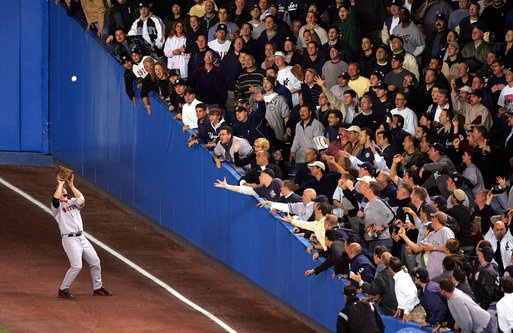
Trot NixonPerforming with Ritt Henn and all those pros was like being asked to play right field for two innings of a Major League Baseball game. I thought, “I can catch a fly ball. I’ve done this a million times.” But in real games, easy flies are intermingled with screaming line drives in the gap, violently bad hops, jeering Yankee fans (see photo), and split-second decisions about which base to throw to. Pros react to these unpredictable challenges as though they expected them — because they’ve practiced for the unexpected their whole lives — and even in the most unusual situations, they execute flawlessly. A pro hits his tee shot into the sand on the 18th hole at Augusta National — and still saves par.

That’s what I learned last Wednesday night in New York. I may know how to play those chords and sing that harmony – I may know how to catch a fly ball – I may know how to drive a golf ball into the fairway – but I’m an amateur. A happy amateur. (Although it sure is fun to hang out with and learn from professionals…)
Never Say “I Could Have Done That”

Creative ideas.

Images of a different, better future.

We all have five or ten compelling ones every day. Sometimes they hit us in the shower. Sometimes while we’re driving. Sometimes when we’re sitting in a meeting oMJ on the Baronsr while talking with a friend. Sometimes they wake us up at 3 in the morning.

And I bet at least one idea we have per day is one that, if acted on, could make a quantum, dramatic difference in our lives or the lives of others. It’s one that could help define our lives and our purpose on this planet if we could execute it. If only these gem-like ideas could be highlighted for us, and we could be guided by a higher power to follow-through on them immediately….

Frequently, I see the work someone else has done – the book or song they wrote that I know I could have created as well, the product they invented that I had the concept for a few years ago, the eye-opening presentation they gave at the conference, the physical condition they’ve gotten themselves into and the accomplishments they’ve achieved because of this – and my impulse is to say, “Well, I had could have done that, too.”

But I didn’t, and that is all that really matters. I may have had the idea. I may have had the ability. I may have had the desire and even the intention. But all the credit goes to the one who takes the idea and, at the very least, strives to forge it into a real thing, a real accomplishment, a real victory, a real process, a real piece of art, a real conversation, a real relationship, a real habit, a real action.

The line between “having an idea” and “executing an idea” is thin – and yet the difference in value between the two is infinite. An idea or goal that stays in your head is as good as an idea or goal that never existed.

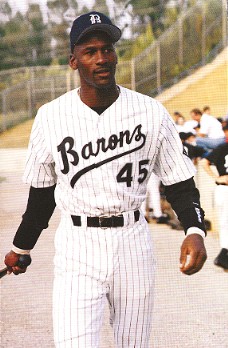
I love the example of Michael Jordan’s short baseball career for two reasons:

1. Michael says he always dreamed of being a major league baseball player and believed he could compete at the highest levels in that sport. Most of us forget that he retired from the NBA as reigning MVP in order to follow through on this dream and start a new career in baseball. Is there a better example of never saying, ‘I could have done that?’ That was one of the most inspiring career leaps I’ve ever seen.

2. M.J. never made it to the majors, but you won’t hear Michael say, “I could have done that,” while watching David Ortiz or Ichiro Suzuki hit a 97-mph tailing fastball for a game-winning hit. He tested out his idea and learned that baseball was much harder than he imagined. But, at least with regard to this single idea, Michael can sleep at night knowing he didn’t let it die in his head.

Then there’s my sister-in-law, Christina Harding. She heard about the Antarctica Marathon a couple of years ago and said to herself, “I never want to just say, ‘I could have done that.’ Therefore, I must do it.” Last week, she competed in the Antarctica Marathon. Like Michael Jordan, she can now say, “I followed through on my idea.” Unlike Michael Jordan, Christina can also say, “And I reached the pinnacle.” Because she won, defeating all other female entrants in the race and passing two competitors in the race’s final two miles of glacier-covered terrain. Incredible.

I have learned to never say, ‘I could have done that.’ Because I didn’t.

Are You Measuring The Right Things?

Wrigley’s fenceSeth Godin describes an example today on his blog that shows that “just because you can measure it doesn’t mean it’s important.” It reminded me of a great book about measurements – indeed, one of the best non-fiction books I’ve ever read.

Have any of you read Michael Lewis’s book, Moneyball: The Art of Winning An Unfair Game? (Even if you couldn’t care less about sports, you’ll enjoy this book.) It’s a fascinating story that provides a perfect example of how “knowing what to measure” can have a dramatic impact on an organization’s results.

A few years ago, the general manager of the Oakland A’s, Billy Beane, set out with some MIT stat geeks to figure out what player statistics correlate most closely to “scoring runs.” What they discovered enabled them to compete on a different level in the game of selecting players. While every other team pursued players with high “batting averages” and “home run totals,” the A’s had figured out that these stats weren’t actually the most important when seeking players who would help you WIN (which is, of course, the ultimate goal).

They learned that “high on-base percentage” and “high slugging percentage” were the statistical qualities that contributed most to winning games — and that many of the players with the best stats in these areas were either overlooked by other teams (who had their eye on the wrong measurements), or undervalued in terms of salary. So, on one of the smallest budgets in all of baseball, the A’s put together a team that competed for the World Championship several years in a row.

How’d they do it? They asked the right questions, did some analysis, and figured out the right things to measure to identify players who could help them achieve their ultimate goal of winning – then they adjusted their game plan accordingly.

What if you could engineer a surge in your results in your own field, similar to the A’s surge in victories, by starting to measure the right things?

Jack Kent Cooke’s letter to me about “success”

jack kent cookeIn 1993, as a 25 year-old middle school teacher, I wrote a letter to every owner of every major sports franchise (hockey, basketball, baseball, football) along with every MLB general manager, introducing myself and asking for advice on “how to be successful.” At the time, I aspired to own a team or become an MLB general manager.


I received about ten personalized letters or phone calls in return, including great letters from Daniel Rooney, president of the Steelers (“Since the Steelers were founded by my father in 1933, I happened to have an “in” with the owner”), John Schuerholz, GM of the Atlanta Braves (“I am somewhat dismayed that a person with the amount of passion you display for teaching and the great rewards it offers might be motivated to leave that great profession for other pursuits”), and kind and supportive calls from Bob Watson (then-GM of the Houston Astros) and Bob Harlan (Chairman and CEO of the Green Bay Packers). But the big daddy of all responses came from Jack Kent Cooke (1912-1997) (pictured above), the former owner of the Los Angeles Lakers and Washington Redskins.


His letter is one of the best – if not THE best letter – I have ever received. I wish you could hold it in your hands – the ivory-colored stationery itself is truly awesome, with an old-time Redskins helment at the top and ‘The Redskins’ in snazzy red letters. At the bottom of the stationery are Super Bowl banners: “Super Bowl XVII Champions – Super Bowl XXII Champions – Super Bowl XXVI Champions,” and at the end of the letter is Mr. Cooke’s elegant John Hancock, signed with his own pen. I’ll share the letter in its entirety here, in its exact original format; it’s the kind of letter that would be sinful to keep to myself:


December 2, 1993


Dear Mr. Crawford


Thank you for your pleasant letter of November 27th, which I received today. I regret that I cannot come up with an easy, simple recipe for success since I believe there’s not a surefire method of reaching the top. But for starters I believe that humanity is divided into three parts:


a) Those who make things happen, b) Those who watch things happen, and c) Those who don’t know what’s happening.


In the course of my life I’ve run across maxims which seem to relate to success. But don’t forget that success frequently is a state of mind rather than a material pinnacle. So, here are a few of those thoughts I have found helpful:


Glory

Robert Burns: “A man’s reach should exceed his grasp or what’s a heaven for.”

Dizzy Dean: “It ain’t braggin’ if ya done it.”


Courage

John Dryden: “I am a little hurt but I am not slain and I will lay me down for to bleed a while then I’ll rise and fight with you again.”


Luck

Branch Rickey: “Luck is the residue of the design.”

Lord Thomson of Fleet: “Funny thing, the harder I work the luckier I get.”

Eubie Blake: “Be grateful for luck. Pay the thunder no mind – listen to the birds. And don’t hate nobody.”

Louis Pasteur: “Fortune smiles on the man who is prepared.”


Practices vs. Theory

Anonymous: “Some Greeks had been sitting on a wall for over a week theorizing which would fall first, a feather or a pellet of lead of the same weight. A Roman came along, listened a few minutes and said, ‘For God’s sake, drop them and find out’.”


Preparedness

Admiral Horatio Nelson: Said he owed his success to “Being there five minutes ahead of the other chaps.”


Intuition

The Bible: “That which is essential cannot be seen with the eye. Only with the heart can one know it rightly.”


The Future

Shakespeare: “Things without all remedy should be without regard. What’s done is done.”


Determination

Churchill: a) “It’s no use saying, ‘We are doing our best.’ You have got to succeed in doing what is necessary.” b) “Never talk monkey when the organ grinder is in the room.”

Henley: “Out of the night that covers me, Black as the pitch from pole to pole, I thank whatever gods may be, For my unconquerable soul.”


Energy

Anonymous: “Enthusiasm is akin to genius.”


Age

Satchel Paige: “How old would you be if you didn’t know how old you were?” b) “Age is a matter of mind over matter. If you don’t mind, it doesn’t matter.”


All The Rules Rolled Into One

Satchel Paige: a) “Avoid fried meats which angry up the blood.” b) “Avoid running at all times. Don’t look back. Something might be gaining on you.”

Carl Rowan: “Every sickness ain’t death, and every goodbye ain’t gone.”

T.S. Eliot: a) “Humility is the most difficult of all virtues to achieve.” b) “Nothing dies harder than the desire to think well of oneself.”


I can only add that it has always seemed to me that if you want something more than anyone else in the world wants it, and that if you’re willing to exercise the utmost intelligence and industry to get it, it will be yours.


Best wishes for success.


Yours very truly


Jack Kent Cooke (personally signed, with the flair of a king)


(Now, do you see what I mean about it being one of the best letters of all time? I have repeated Mr. Cooke’s philosophy on the three parts of humanity, and his final sentence about wanting something more than anyone else, many times to many people. Now, I have finally shared it with everyone else in the world.)